|
What about 'Knowledge of Philosophy'?
|
I recently read that there are only
three interview questions:
- Can you do the job?
- Will you love the job?
- Can we tolerate working with you?
In the past, I haven't had a lot of trouble with these three. My problem is:
- What's with the PhD in philosophy?
There are plenty of reasons not to fret about this. I doubt my answer matters much given my ability to answer the other three. Plenty of people take a non-linear career path, and there are lots of reasons to get a PhD--it has helped me to get noticed, if nothing else. Finally, a PhD in, say, computer science probably wouldn't give me any more special knowledge than one in philosophy, because what I would have studied would have been so specific and so quickly dated. Still, the question comes up often enough in normal conversation that I'd like to be able to give a reason more interesting than 'broadening my intellectual horizons' and shorter than my dissertation. Here's my attempt.
A degree in engineering (and some experience in the field) shows you
how to solve problems, but it doesn't provide much help in figuring out questions like 1) What
should I solve? 2) What is it
right to solve? At Penn State, the main recruiting industries were military. I knew that I didn't want to kill people, but I didn't know much besides that. I lacked direction, and the only guidance I got from my computer ethics class (Ayn Rand) wasn't particularly helpful. (She says: go do great things, but what were those things I should be doing?) My philosophy classes were more promising, but they really only whetted my appetite.
In grad school I focused on moral and political philosophy. That is, instead of trying to prove or disprove God's existence or understand how we can know anything, I was interested in: 1) What is the Good? and 2) What is the Just? These problems were particularly difficult because, like most non-fanatics, I didn't think there could be just one answer. But my moral intuitions gave me reason to suspect there had to be some kind of answer. It's that space between 1 and infinity that's tricky.
It took some work, but eventually I became a philosophical pragmatist. I realized that, like most philosophers today, I thought I had accepted that there was no Absolute Truth when I was really still hankering after It. Pragmatists have a good explanation of relativism without believing that whatever you think is the right thing to do. (If you're really interested, start
here). You simply can't accept that there are multiple right answers and keep asking the same old questions, like 'What is the Good?' or 'What is the Just?'
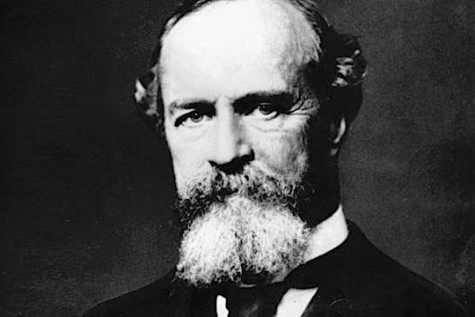 |
James figured out a new way of thinking with an old name
|
Pragmatism involves bringing scientific thinking to all areas of life, including moral and political questions. What most people don't realize is that science has become relativistic in the 20th century. From Heisenberg's uncertainty principle to Godel's incompleteness theorem, scientists have stopped looking for absolute truths and now couch their hypotheses in terms of the highly-specific and reproducible experiments. One cannot extrapolate beyond those experiments for all situations and times. Brian Cox often says that there's no good reason to assume scientific 'laws' will hold for any amount of time--we simply find that they do so in many situations.
Pragmatism is important for thinking about technology in at least two ways: 1) It helps us
reconcile morals with science. For example, if new technologies make the consequences of our actions very widespread, we must become more knowledgeable about them in order to realize our moral principals. 2) On a social scale, it shows us how to think about
technology and the greater good. For instance, instead of thinking about technology as just a tool or as the savior of mankind, we should look at how some technologies help us solve certain collective action problems. In either case, the main point is to look at concrete problems and technologies, not technology, morality, or justice in general.
All this is very brief, but that's because it's what my blog is all about: applying principles to specific problems. I still tend towards the overly-philosophical side, but I'm getting there.