
I had a computer science professor in college that praised big companies like AT&T and IBM because of all the amazing innovations they produced. Big companies, he argued, have a lot of money to put into R&D. Think about Bell Labs in 1948. In one year, both the transistor and communications theory are invented there. Stephen Johnson too praises universities and research labs like CERN, because they provide an open environment for wild ideas.
But, as Tim Wu--the law professor who coined the term 'net neutrality'--convincingly argues, this isn't the whole picture. Bell Labs clamped down on a number of innovations, such as the answering machine (first invented in the 1930's!) and the Internet, which only became a reality when JCR Licklider was hired at ARPA and made Paul Baran's packet-switching ideas a reality. AT&T did, of course, host the lines connecting the nodes of the ARPANET. But they could not be persuaded by Baran to move from a hierarchical system to a peer-to-peer system before then.
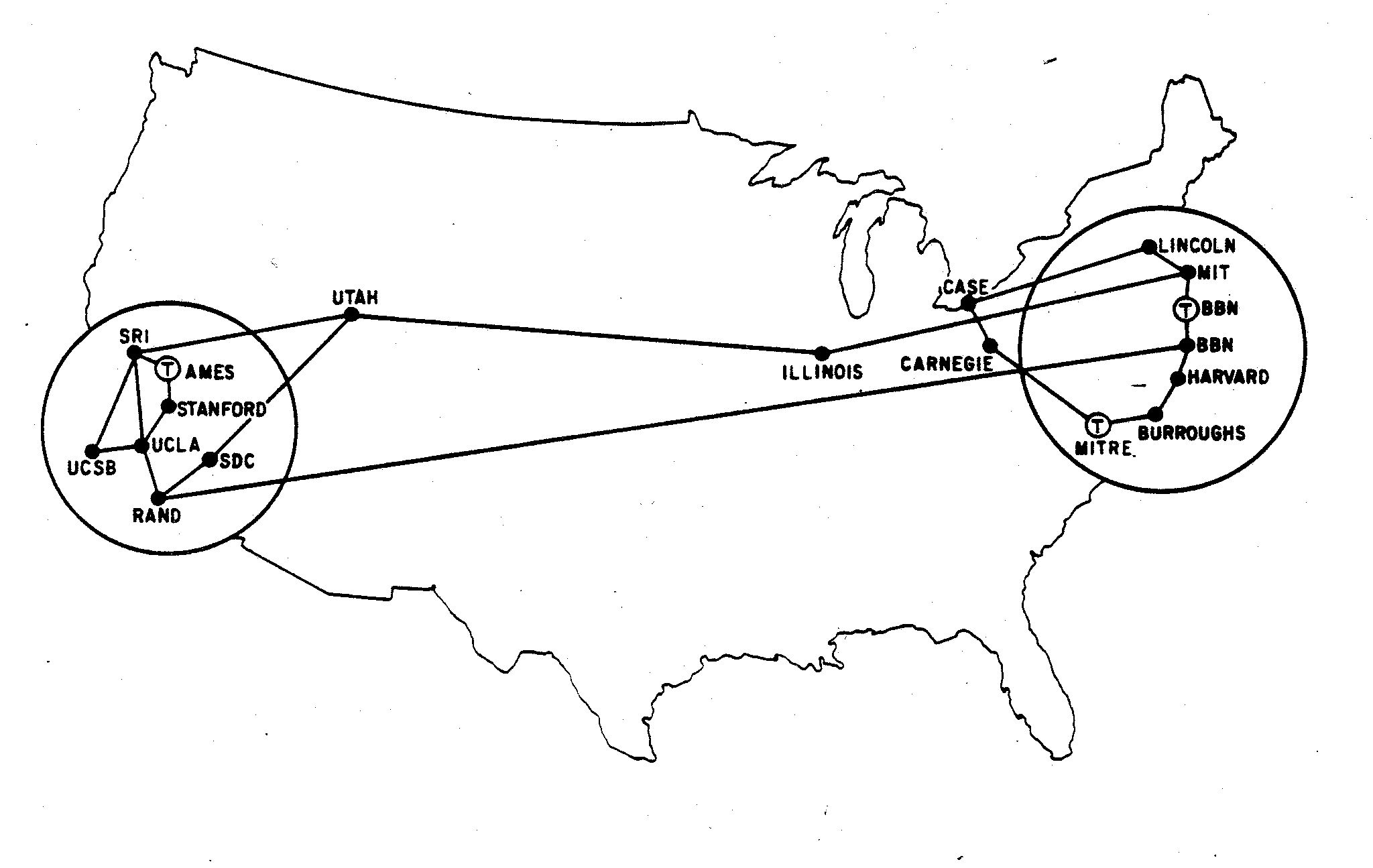 |
| ARPANET in 1971 |
Companies tend to innovate within their area of dominance. Promoting any radically different technologies is risky. The radio companies understood this when television was invented. They got the FCC to regulate television to such a degree that only established players like NBC had a chance. Imagine what television could have been like if it wasn't legally required to have centralized networks that created a small amount of content for large audiences on an advertising model. An early YouTube, perhaps?
Communications technologies have three components: content production, distribution, and receiving technologies. During its monopoly, AT&T controlled both the lines and the receivers; ordinary people produced the content. Broadcast television had only three content producers who sent signals over airwaves which were picked up by televisions. Hollywood was so vertically integrated in the 30's and 40's that it produced the content, distributed movies, and owned the theaters that showed them. With the Internet today, there are many producers, a few connectors (such as Google), and consumer devices like smartphones and laptops.
It's easy to think that the Internet is radically different from other communications technologies, but Wu doesn't think so. Whenever a new technology comes out, people think it will cure the world of all its ills. The telephone connected even the most rural farmers to their neighbors on barbed wire fences, until AT&T drove these coops out of business. Cable television promised to democratize information and liberate us from the tyranny of the big three, but it's hard to think of cable TV as emancipatory today. Even Hollywood was founded on principles of openness and was the result of breaking up the Edison Trust motion picture monopoly.
 |
| The old Bell is the new AT&T |
The more components of a communications technology that any one company owns, the more control they have over the flow of information. If the AOL-TimeWarner merge was not so ill-timed, the results could have been scary. One company would control the content, the connectors, and the access for millions of people. In effect, it would have a 'master switch.' Though many pundits worry about Google's ability to direct traffic to a few key sites, it would not be hard for content-producers to refuse to let Google index them. They could connect directly with consumer device producers, which is exactly what Apple has been trying to do.
To be honest, I never worried much about net neutrality before. But now that AT&T, Verizon (which is just AT&T East), and TimeWarner (a content-producer as well) are the main Internet service providers, they wield a great deal of power. The content-producers (YouTubers) and distributors (Google) both need AT&T and Verizon to connect. The Internet may share the same fate as all other communications technologies. And because it's become so ubiquitous that it's all the more important for it to be open. That's why I think I'll stick with my Android phone.
Other fun facts about open technologies:
- The explosion of movies like Midnight Cowboy was not just due to Americans watching French New Wave movies. It was probably more likely the abandonment of the Hollywood code in 1968. The code itself was only possible because there were so few movie producers.
- FM Radio was invented in the 30's but so regulated by the FCC at the behest of NBC / RCA that it didn't become a viable option until the 70's, even though it had better sound quality with lower power consumption than AM Radio.
- The main reason TCP/IP caught on was that it was network agnostic. It was an ad hoc solution to an early problem of connecting disparate networks, but its longevity is due to its flexibility and abstractness.


