Showing posts with label Work. Show all posts

Saturday, March 9, 2013

How To Make A Scene

The toilet at CBGBNot for those with low constitution.
The number of great bands to play at CBGB in the late 70's and early 80's is hard to fathom:  Ramones, Misfits, Television, the Patti Smith Group, the B-52's, Blondie, Joan Jett, Talking Heads, Agnostic Front, and Sick of It All, to name a few.  CBGB was a disgusting dive bar in a sketchy neighborhood.  So why was it the incubator for so many famous acts?

David Byrne offers a few suggestions.  In his How Music Works, he tells us how to make a scene.  You need:
  • A venue of the right size
  • where artists can play their own material
  • and listen to each other for free;
  • and where patrons are free to pay attention or not.
  • A sense of alienation from the mainstream scene.
  • Cheap rent.
Note that these factors are necessary but not sufficient for creating a scene.  You can't will a scene into existence.  It has a life of its own.

Note also that many of these factors relate to a venue.  A scene needs a location.

It's interesting to hear Byrne reflect on this time.  Surprisingly, he didn't notice anything revolutionary going on.  He remembers some good bands as well as some really bad ones.  There was also nothing romantic about the time.  It's just not cool to see winos passed out in the street or to have to use the bathroom at CBGB.

I haven't heard of many companies trying to make the next Ramones, but it seems like everyone wants to create a good corporate culture (even if it's by banning telecommuting).  Similarly, every city wants to be a technology hub like Silicon Valley.  Creating a culture is like making a scene.  But how do you do it?

In the mid 90's AnnaLee Saxenian compared Silicon Valley to the Route 128 corridor outside Boston.  She found that, though both had a lot in common, such as proximity to great schools, Silicon Valley flourished because of its decentralized and open communication networks.  People came and went, kept in touch, formed start-ups, and generally talked freely about ideas.  Route 128, however, petered out due to its centralized and secretive culture.

A study cited in Peopleware showed that productivity correlates most to office location, not to years of experience or programming language.  Their conclusion is that productivity is inversely tied to the number of times people are interrupted in a day.  In other words, it's the venue that matters most.  With the advent of iPods, voicemail, and telecommuting, interruptions may not matter quite as much as in the Peopleware study.  Still, a good culture is about more than freedom from interruptions.

The problem is that it's hard to draw many lessons from studies like these.  They often come in the form of negative commandments.  Peopleware says: Don't interrupt people.  Don't rush things so that people cut corners on quality.  In Rework, the authors say: Don't treat people like kids.  Don't keep them late.  Don't create policies after the first offense.

But it's pretty hard to show that any of these rules are actually necessary.  The form of inquiry can't really be scientific.  How do you know when you've removed blockages to a good culture but one happens not to emerge, and when you've missed another important rule?  When you're talking about culture, you're interested in the necessary but not sufficient.  There are no necessary and sufficient conditions.

Sunday, March 3, 2013

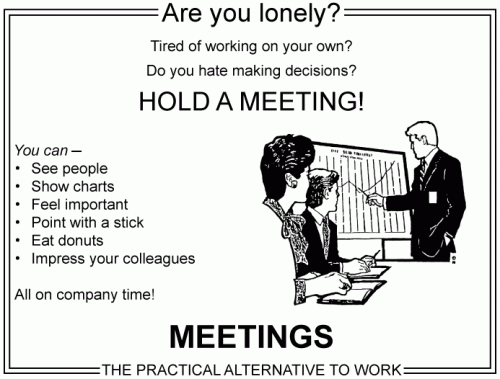
The Practical Alternative to Work

Meetings don't seem very interesting, but they're worth thinking about.  You have to have meetings if you work in a knowledge industry.  Concepts are slippery, and it's important that everyone is talking about the same thing.  (That is, you have to 'be on the same page' about the 'business logic.')  If you're not in agreement, then analysts specify the wrong thing, developers build the wrong thing, QA validates the wrong thing, and users sign off on the wrong thing.

Now, there are different kinds of meetings.  Big, scheduled meetings tend to be a waste of time.  If you have ten people sitting around a table for an hour, that adds up to ten hours.  They also tend to produce the appearance of agreement.  It's only when you get to working that disagreements arise.  Finally, there's always someone who cannot stop themselves from talking (this is called logorrhea).


So, I try to have smaller, impromptu meetings.  The problem with these is that they can lead to a lot of interruptions, which can be just as bad as big meetings.  In theory, a larger meeting can get all your interruptions out of the way at one time.  But, as we've seen, it doesn't always work that way.

They guys at 37 signals have a few suggestions:
  • Set a 30 minute timer. When it rings, meeting's over. Period. 
  • Invite as few people as possible. 
  • Never have a meeting without a clear agenda. 
  • Begin with a specific problem.
  • Meet at the site of the problem.
  • End with a solution and someone responsible for implementing it.
I think these are all good ideas, but I don't think it's so easy to have a clear agenda.  Even if you agree about the problem, meetings can be like classes where no one wants to teach.  Or, even if someone wants to teach, no one wants to pay attention (just like high school).  You can't plan the perfect meeting, because you can't control people or predict what they'll do.  I think that's one of the cool things about working with smart people, actually.  If people didn't surprise you, work would be really boring.

So what can you do?

First, don't waste your time in meetings you have no interest in attending or ability to contribute to.  I go to meetings late and leave early all the time.  This is responsible behavior.  There are simply better uses of my time.  Just say, "Are there any other questions for me?  No?  Let me know if anything comes up."

Second, prepare for meetings, even if you're not leading them.  I often write an email to meeting participants ahead of time with a list of questions or things to talk about.  You don't have to stick to it, but it helps guide the conversation.  And, if anyone reads the email, they can respond to your questions and move the meeting along.  Just say, "How about we start with my list of questions?"

Finally, write on the board, or a piece of paper if it's a small group.  It is so easy to get lost in abstract concepts and systems that everybody needs to see the same thing.  Stand up and play teacher.  This is not your big chance to explain everything to everyone.  Instead, you should be a conduit for everyone else.  In my experience, good teachers help students connect their own ideas rather than impose a solution.  Just say, "Let's get this on the board.  What is the first step?"
Related Posts Plugin for WordPress, Blogger...