Showing posts with label Economics. Show all posts

Sunday, February 3, 2013

Starting Strength

"Physical strength is the most important thing in life." 
I love opening lines like this.  It's from Mark Rippetoe's Starting Strength, the gospel of barbel lifting.  Rippetoe is worth your consideration, even if he recommends squatting three times a week.  He's a gym owner, trainer, and author.  At 56, he can deadlift 500 lbs.  He argues that humans evolved to deal with physical strain, and the cushy lives many of us now lead don't erase millions of years of evolution.  At base, we're physical creatures.  For this reason, exercise isn't a cure for health issues; it's the thing without which we can't be healthy.

The fun thing about lifting weights is that you get stronger over time in an easily measurable way.  You don't have to guess to see if it's working.  The way to do it is to start with small amounts of weight and increase incrementally.  If you work your way up, your muscles and bones will get stronger, your posture will improve, and you'll be able to deal more effectively with athletic and everyday strains.
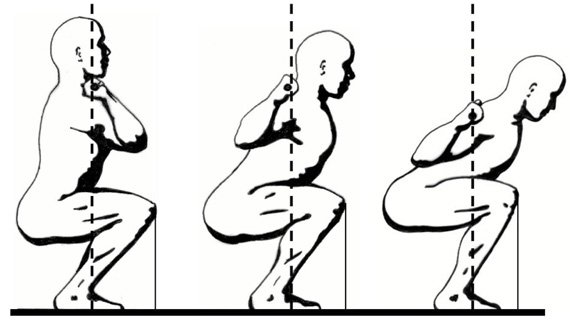
Squats should be done naked and hairless

I can testify that my running ability has improved since doing squats again (though not three times per week).  After getting a stress fracture in my hip last year, my theory is that squatting will strengthen my bones and musculature so that it doesn't happen again.  We'll see.

Rippetoe provides a nice example to help understand how your body adapts to stress.  Imagine you want to get a base tan for the summer, and you decide to lay outside at lunch 15 minutes (7.5 minutes each side) per day for an entire month.  You might think you'd get pretty tan.  But because your body will only grow to withstand 15 minutes of sun, you'll be only a little darker.  In the same way, you can't go to the gym every week, lift the same weights, and expect to get stronger.  Your body will only get as strong as it is challenged to be.

It may seem obvious that we get stronger by gradually increasing strain on our bodies, but it's actually kind of remarkable.  If you gradually increase strain on a glass or even a rock, for example, it will just fracture.  Bodies, like economies, are complex systems that, when stressed, become stronger.  Or, at least, that is Nassim Taleb's argument in a recent book.  Taleb is an investor and a professor of finance, and he became famous for predicting the financial crisis of 2008 in 2007.

When we try to insulate complex systems from smaller shocks, we are less able to deal with bigger shocks, or what Taleb calls 'black swans' (no relation to the Aronofsky movie).  According to Taleb, mainstream economists are to blame for the seriousness of the current recession.  They believe that recessions can be avoided altogether through the policies of governments or central banks.  But while it may be possible to cushion small shocks, such periodic strains actually make economies stronger and so should not be anticipated or minimized.

The 2008 recession or a failed attempt to move the fridge?

Enough about economies and bodies.  What about, say, brains?  Studies show that keeping up mental activity after retirement can help stave off Alzheimer's.  This makes sense: if you don't use it, you lose it.  However, I'm not sure that trends like Sudoku do much more than improve your Sudoku abilities.   This is one reason why many retirees return to school.

The latest trend is sites like lumosity.com, which promise to improve your memory, attention, and IQ.  Again, the piecemeal approach these sites take is like doing Nautilus machines at the gym.  Why work out one muscle at a time when you can do squats, which will work dozens of muscles, improve balance, train coordinated movement, and strengthen your 'core'?  That is, squats increase your strength in the ways you'd actually use your muscles.  Why stare at a screen doing n-back games when you could read a book, take a MOOC, raise a child, have a stimulating conversation, or pretty much do anything in a reflective way?  That is, why not work your brain out in the ways you'd actually use it?

Sunday, April 1, 2012

Accounting and Thermodynamics

Predator-vision
A few years ago, I rented a very cheap house in a very cold part of the country. I wanted someplace big to play my drums, but I didn't realize what kind of heating bills I would get in the winter. I ended up keeping the house at 40 degrees Fahrenheit, using space heaters, and freezing a few pipes.

Besides earning a story to tell, I also learned how to see rates of flow. I was suddenly able to see the various heat sources and sinks in my house, with vectors of various strengths showing the direction and rates of flow. Unconsciously, I had always thought of heat as being a property of a room or building, but I now saw heating the way physicists see it.

Locke-vision
Such paradigm shifts, which overlay your present view of the world with a broader experience, are not uncommon. I always enjoyed studying geology, since it allows you to see the seemingly-fixed landscape as a fluid process and to see human activity from the perspective of the Earth. For thousands of years, astrology let people interpret ordinary events through the lens of the cosmos.

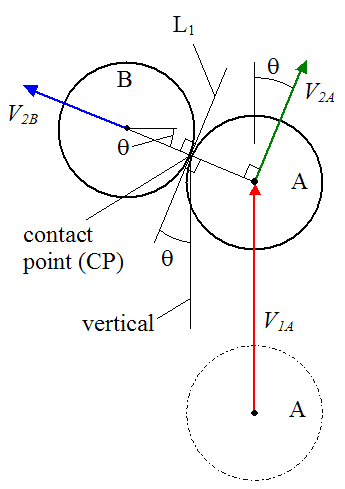
One of the most natural ways of seeing the world is as a collection of things with properties. This view was best put down on paper by modern philosophers like John Locke. They went back and forth about how subjective 'secondary' qualities like color and taste could be known to be true to the 'primary' essence of a thing, but they never questioned the atomistic model of the universe. This was only natural when the physics of the day characterized the interactions of the universe by analogy to billiard balls.

I've been trying to get my head around some hard accounting problems, and I realized that my problem was thinking of accounts as things with properties. It is correct, in a sense, to describe accounts as having a dollar amount. But is is more correct to think of them as part of a system of interconnected accounts with various directions and rates of flow, much like the heat in my cold house. This is because the value of an account is constantly changing, and because its changes are the direct result of transfers from other accounts. Even the cash in your wallet is not separate from this plumbing. I've begun to see the systems I build and maintain as part of the flow of the entire monetary system.

This flow is becoming particularly interesting with the growth of currency-less transactions like ACH. If you get direct deposit, you use ACH. In the future, there will be no paper or coin currency. We'll simply transfer funds between accounts with smartphones or other devices. There are many fascinating consequences of the death of currency. For instance, if governments do not have to pay the cost of printing money, the cost of transacting will be borne by retailers in the form of transaction fees. Someone will also need to bear the cost of information theft when you lose your phone.

$0.01, spent at all places and times
But I have a really crazy thought.  If money becomes infinitely liquid, won't its velocity increase infinitely, thus increasing the money supply infinitely, and raising the cost of everything infinitely? I wonder if the the laws of thermodynamics will continue to hold as currency becomes digitized. With real-time web services and other technologies that take us away from daily batch file ETL common to financial systems, we increase the liquidity of money with consequences that are not yet clear. Instead of rates of flow, we may have currency that is in all accounts at all times, much like the Heart of Gold's Infinite Improbability Drive. But I suppose I shouldn't borrow serious thoughts from Douglas Addams.

Sunday, February 26, 2012

Find Your Denominator

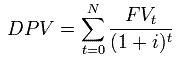
What is finance? I'm glad you asked. Having passed an online course, I'm now an expert. Finance is about comparing investments so that you can make decisions about what to invest in. A dollar today is worth more than a dollar tomorrow, because it could be invested today (this is called the 'time value of money.') The problem finance tries to answer is: exactly how much is a dollar tomorrow worth today? The answer: lots of series and ratios.
discounted cash flow formula
The answer?
Really, this answer isn't so clear. It may appear to the layman that finance is just applied math, in which you can plug in a formula and get the right answer. But if this were the case, no one could make money, because everyone would have perfect information. (In this way, finance is predicated on rejecting the fundamental assumption of classical economics.) The math quickly falls away, either because few variables are certain or because there are many ways to calculate present value, depending on what assumptions you make.

What are you left with? Judgment, just like any other field worthy of intellectual pursuit. If finance could have been automated by computers, it would have been by now (never mind High Frequency Trading). Becoming good at finance is a matter of knowing which formula to apply when, or how to prioritize which evaluations. This involves experience and general principles, not rules. If you didn't like word problems as a student, don't go into finance.

good to great by jim collins
Not bad
Jim Collins makes this point in his book Good to Great. He argues that since gross profit comparisons in themselves are not very useful, companies need to discover their particular ratio that slices through the numbers. For an architecture firm, this might be profit / design. For an eCommerce site, it could be profit / transaction. For a real estate agent, it may be profit / time on the market. You have to find your economic denominator. These are not formulas they teach in business school, and they are not always obvious.

For IT professionals, all this suggests that the people in suits might not know what they want to see. This has nothing to do with the typical IT complaint that business users don't know what they want, because they don't understand the technology. Rather, there is an element of uncertainty at the heart of financial planning that has nothing to do with technology. Key Performance Indicators are not given and they will change as a business and its economic climate changes.

This uncertainty is a boon for IT people because, sometimes, knowing enough to be dangerous about something allows you to think more creatively than those indoctrinated by a professional education. Get data on everything. Enable users to compare crazy things. Make a tool that charts profit per every single metric you have available. Some might not make any sense, but some might just be the KPI your business has been looking for. Even if you're not a licensed data scientist, you can play the part.
Related Posts Plugin for WordPress, Blogger...