Showing posts with label Philosophy. Show all posts

Sunday, August 3, 2014

What Time is it?

From this deduction of our faculty of cognizing a priori there emerges a very strange result, namely that with this faculty we can never get beyond the boundaries of possible experience, that such cognition reaches appearances only, leaving the thing-in-itself as something actual for itself but uncognized by us. -- Imannuel Kant, The Critique of Pure Reason
The question of whether a computer can think is no more interesting than the question of whether a submarine can swim. -- Edsger Dijkstra, The Threats to Computing Science
In the late 1700's, Kant decided to demonstrate the limits of thought. This is not so easy, because we can think of all sorts of things that are impossible, like flying horses or projects that ship on time. Furthermore, the only tools we have are our pitiful human brains. The only way we can undertake to critique--i.e., set bounds to--pure reason is by reason itself. Kant's conclusion is that our understanding is limited by the structure of human experience. We can't be sure of grasping things as they truly are.

Which metaphysics is right is still up for debate, but we have made major inroads in the somewhat related field of computability. Of course, things are a bit easier here, since we're the ones who thought up the idea of computers, and they do what we tell them to do (for the most part). However, the idea is roughly parallel. Theoretical computer science is to computers what metaphysics is to thinking. Kant's question was: What is it possible to know? The question facing theoretical computer science is: What is it possible to compute? Since computers cannot think, as Dijkstra reminds us, we should be content with this more reasonable question.

In a later post, I'll talk about computation from the side of computability, which involves lots of serious proofs to determine what is logically possible for machines to do. Here, I'll discuss complexity theory, which asks: What is within the computational ability of actual computers, considering the real limitations of time and space?

One of the basic problems of computing is figuring out how much time it takes for a computer to solve a problem. As Donald Knuth found, it all depends on your problem and the algorithms you have available to solve it. Some problems take a polynomial (P) amount of time to be solved, which means that, as the input size increases, the amount of operations needed to solve the problem increases on the order of xn, where n is an integer. If you have a list of 100 items, and your algorithm is on the order of x2, it will take around 10,000 operations.

Some algorithms, however, grow with non-polynomial (NP) or exponential time as input size increases. They're on the order of nx, where n is an integer. With small input sizes, this is not so bad. But with an input size of only 100 on an O(2x) problem, you're looking at around 1,267,650,600,228,229,401,496,703,205,376 or > 1.3 * 1030 operations. That is a lot. If you can do 10 trillion operations per second, that will still take far longer than the lifetime of the universe to finish--about 100 quintillion years.

NP problems are not esoteric. They're often graph problems, liking trying to determine the shortest distance someone can travel in order to visit a bunch of places without visiting the same one twice (the travelling salesman problem). Any problem involving scheduling or fitting items into boxes is NP too. I've often wondered how the modern world of logistics is possible, considering all of its problems are NP!

Theoretical computer scientists have shown that some problems are NP-complete, meaning that other NP problems can be reduced to them. They're the hardest possible problems to solve in NP time. The first problem shown to be NP-complete is Boolean satisfiability (or SAT), which involves determining the values of variables in a Boolean expression such that it evaluates to true. Since NP problems are so important and so intractable, many people have hoped to find a way to solve an NP-complete problem in polynomial time. If this happened, all NP problems would suddenly become tractable.


I'm not holding my breath for anyone to show that P=NP or to invent a non-deterministic computer, which would branch its computation at every decision and run NP problems in P time. So, what can you do?

Years of research have come up with a few ideas. If your run-time is NP, you can do a lot of preprocessing, as long as it takes polynomial time. You may be able to eliminate a lot of obviously wrong choices, or you may be able to figure out certain elements of a solution. For example, if your boolean satisfiability problem has a term by itself, it must be true. With preprocessing, you can get performance down to O(1.4x) or so on some problems.

Another option is to find a slightly easier problem. If you don't care about obtaining the best possible solution, you can usually find an algorithm that performs no worse than twice as badly as the ideal. For example, greedy algorithms tend to do pretty well on graph problems, though there are pathological cases. For many applications, it's better to have a reasonably good answer than none at all.

To be honest, though, I've never run into a problem at work where I even had to consider NP solutions. Perhaps I have been lucky (or perhaps it's because I don't work in logistics!). It's worth wondering how important it is to know about the issues facing NP algorithms. For one thing O(1.1x) is better than O(x10). Furthermore, there are problems that are even harder than exponential problems, such as finding a winning move in chess. Each move has a tree of exponential solutions to investigate.

I think the important thing to understand is that certain problems get really hard to solve really fast. Computers follow instructions, and if the only possible instructions require looking at a huge number of possible solutions, it's going to take a long time. Humans process a lot of information very quickly because we filter out much more than we pay attention to. Until computers become better pattern-matchers, they won't be able to match our speed in processing large input sizes. This is why there is so much interest around machine learning now, though programming computers to be better pattern-matchers will have its own problems, since heuristics always fail for outliers (see Kahneman's Thinking, Fast and Slow).

Most theoretical computer scientists do not think P=NP. This is probably a good thing--at least for the time being. Cryptography, for example, would cease to be possible if prime factorization algorithms could be solved in polynomial time. You remember Sneakers, right? Anyway, I think it's more interesting to try to make computers smarter than to try to make them faster at doing stupid things. In other words, we shouldn't hope to get computers to grasp the thing-in-itself through further and further analysis; we should seek to change the structure of their 'experience.'

Sunday, February 9, 2014

Information and Identity

We like to think of ourselves as somehow apart from all this information.  We are real — the information is merely about us.  But what is it that is real?  What would be left of you if someone took away all your numbers, cards, accounts, dossiers and other informational prostheses?  Information is not just about you — it also constitutes who you are.  -- Colin Koopman
In the last 100 years, many philosophers have explored the ways in which identity is shaped by cultural norms, concepts, and practices.  Michel Foucault is famous for having shown how very basic ideas, like sexuality and sanity, have changed over time as cultures have changed.  Concepts like 'sane' or 'straight' empower some at the expense of others, but there is no man behind the curtain forcing us to think about ourselves in a certain way.  We do it to ourselves.  For example, we police ourselves when we have thoughts that are 'crazy' or 'deviant,' and we treat others according to how they match up to our expectations, for instance by shunning or even institutionalizing them.

Colin Koopman, an old colleauge of mine, recently published a great piece in the Times' Stone series.  Too much technology writing is either breathlessly optimistic (this new technology will save the world!) or pessimistically tears apart the weak arguments of the optimists (never a hard thing to do).  Koopman's approach is different.  When discussing the value of technologies, he says, we need to consider how they impact our identities.


In some ways, this idea is obvious.  Information technologies, after all, are about information, and you can't understand yourself or anyone else without information.  But few people are actually talking about this.  For example, self-monitoring technologies are changing how we think about ourselves.  People are quantizing, sharing, and comparing their fitness activity, their sleep, and their (supposed) mental acuity.  What kinds of values do these technologies embody?  Do they help us become more moral, just, or honorable?  Do they make us better friends or family members?  The things we spend our time doing shape who we are, and taking the time to do one thing means we don't have time for something else.

Koopman is particularly interested in the information technologies associated with governments, which are used to monitor and control us.  When you know that your phone calls are being surveilled and that a record is being kept on you, you act in a certain manner.  If you don't, you may not be able to get a job, or you may even be detained indefinitely.  A hundred years ago, you could leave town if you got into trouble, but now your record travels with you wherever you go.  'Identity theft' means that someone has gained access to private data, not that they have stolen someone's personality or personhood.

Since philosophers can't provide solutions, Koopman doesn't offer one.  The philosopher's job is to help us think better about problems.  As a society, we need to decide what kinds of information should exist, what kind of monitoring is legal, and what kinds of categories should be used to define us.  Technology writers should stop praising or condemning technologies in general and should us talk about what kinds of technologies we actually want.  And we all need to think about what kinds of people specific technologies make us, and whether or not those are the kinds of people we want to be.

Saturday, February 1, 2014

Two Ideas

In the 1930’s, Claude Shannon had two ideas that gave rise to modern computing.  The first is that logic can be expressed in electrical circuitry.  In 1854, Charles Boole developed a form of logic in which the only possible values are true and false.  The possible operators are ‘and’, ‘or’, and ‘not.’  Before this, the dominant form of logic had been developed by Aristotle.  (All men are mortal.  Socrates is a man.  Therefore, Socrates is mortal.)  Boole’s logic made set theory and statistics possible.

Shannon realized that the presence or absence of a current could notate truth or falsity and that Boolean operators could be implemented using simple circuits.  ‘And’ can be implemented by a series circuit.  ‘Or’ can be implemented by a parallel circuit.  And ‘not’ can be implemented by a relay.  These simple components are the building blocks of today’s more complicated machines.

Shannon’s other idea is a postulate that all information can be expressed in Boolean logic. This postulate defines the field of information theory.  It is now obvious to us that all numbers can be represented using a binary number system and that all symbols can be codified in systems of representation like ASCII, but this was not at all obvious at the beginning.  Many early computers, like the ENIAC, still used a decimal number system, for example.

Here’s a simple example showing these two ideas at work.  A one bit adder can be built using an exclusive or (XOR) gate and an AND gate.  The truth table is:

INPUTS                 OUTPUTS
A             B             SUM      CARRY
0              0              0              0
0              1              1              0
1              0              1              0
1              1              0              1

In logic gates, this can be implemented using the following:


Just stop and think about this.  Using two very simple components we have implemented an adding algorithm.  It even carries the one.  You could chain a few of these together and add numbers as large as you like.  Just rig up some light bulbs, power sources, and switches, and you'll have your I/O.

It’s hard to appreciate now just how much of a conceptual leap Shannon's two ideas were.  I took multiple semesters of computer hardware design and never really got it.  Charles Petzold’s book Code helped.  He shows how simple the technologies at the heart of computing really are.  In fact, they had been around for a hundred years before Shannon’s work reconceptualized the ways those technologies could be used.  Petzold shows how telegraph relays can be used to build a complex adding machine.

I’m fascinated by Shannon and the history of early computing, even if it’s not directly relevant to my work.  Modern programming languages are so far abstracted from physical computers that I doubt if studying electrical engineering can have much benefit to programmers.  If it’s worth studying, it’s as a system of thought, like physics or chemistry.  But it’s also worth considering these two ideas from time to time.  Are there any forms of logic that cannot be captured by computers?  Are the audiophiles right that analog sound is better than digital?  What gets lost in the translation to transistors?

Finally, the birth of computing is simply an interesting moment in intellectual history.  Shannon’s two ideas let us leap over Babbage, whose difference engine was never completed.  Babbage basically has no intellectual inheritance.  Even if the analytical engine “weaves algebraical patterns just as the Jacquard-loom weaves flowers and leaves,” in Ada Lovelace’s words, punch cards were arrived at independently.  The Von Neumann architecture owes nothing to Babbage's design.

Saturday, October 26, 2013

Inca vs. Spaniard

Olduvai Stone Chopping Tool, 2M BC
The oldest technology is food production.   A few million years ago, humans chipped their first stone tools used to cut flesh, break bones, strip trees, and peel roots.  The nutrients our ancestors harvested using such tools set off a virtuous cycle of increased brainpower and better tools.  500,000 years ago, we were making handaxes, and, relatively soon, lasting art. 

Food production is at the center of any civilization.  Agriculture provides a surplus of calories which leads to population growth and a division of labor.  Soon after plants and animals were domesticated, humans created the first governments that paid craftsmen to create public art, like the statues of Ramses II.  Government bureaucrats needed a way to keep track of food distribution, which led to the invention of writing.  This same pattern can be seen in Sumer, Egypt, the Indus River valley, the Yellow River valley, Mesoamerica, and Peru--the so-called 'cradles of civilization.'

It seems odd to think of food as a technology, but it's hard to imagine an industrialized America powered by taro or sago, the foods domesticated in Papua New Guinea and that barely provide enough protein to live on.  According to Jared Diamond, our ability (or inability) to domesticate plants and animals throughout the world led to the drastically different rates of technological progress which, in turn, led to Europeans colonizing the world.  I recently spent a couple of weeks in Peru and visited a number of Inca sites, including Machu Picchu.  It was hard to understand how 168 Spaniards could defeat 80,000 Incas when the latter were able to produce incredible fortresses and stonework, like at Saksaywaman.  Why didn't the opposite happen?  Why didn't the Incas sail to Spain and defeat Charles V?

Making corn in the Andes ain't easy.
The short answer is: because corn took a long time to domesticate.  It wasn't until 2,500 BC that corn was domesticated and spread through the Americas.  Scientists still argue about how it was done, since modern corn bears no resemblance to probable progenitors, i.e., teosinte.  In contrast, wheat and barley may have been domesticated as early as 20,000 BC and were pretty much ready for the taking in the Fertile Crescent.  Furthermore, all five large domesticated animals (cows, pigs, sheep, goats, and chickens) come from the Middle East.  Alpacas and llamas were domesticated in Peru, but they don't provide milk and can't be used as beasts of burden.

These differences in food technology gave Eurasia a long head start over the Americas.  They led to technologies like sailing ships and guns, and the close contact of many humans with many animals led to nasty germs like smallpox, which killed far more people than any Spaniards did (80-90% of local populations, by some estimates).  The Incas didn't even have written language (though they had a system of knots called quipu, which could be easily carried by messengers), so they could not read about Cortes's conquest of the Aztecs/Mexica.  They had no reason to assume that a tiny group of Spaniards could or would capture their king (who was a god, after all) and enslave them.

When I think of technology, I tend not to think about food (unless it's GMOs).  Maybe I'm too immersed in computers and code.  Historically, however, food technology has been a major factor--perhaps the biggest one--in how we live our lives.  I wonder if a similar history could be written about clothing or shelter.  In any event, it's important to put new technologies like Web 2.0 into perspective against long-term historical trends.  Is Facebook really the new corn?

Sunday, May 12, 2013

I Know What You're Thinking

Back in grad school, I had a professor who told me about an interdisciplinary summer retreat he had been invited to years ago.  There were economists, political scientists (like him), sociologists, educational theorists, philosophers, and many other smart people.  Though they talked about a wide range of topics, he found it most interesting that, by the end, he could predict the kinds of questions people were going to ask before they asked them.

Economists would wonder about incentives, transaction costs, and barriers to entry.  Sociologists re-framed things in terms of demographics and norms.  Educational theorists were concerned about developmental impact.  Philosophers and English professors would bring the conversation back to 'the text.'  Political scientists would analyze power relationships and procedural constraints.  And so on.

This story has stuck with me for years, especially as I experienced the same thing myself in a similar summer seminar.  On the one hand, it's no surprise that professionalization teaches you a conceptual system with a specialized vocabulary, and it shows the value of doing so.  On the other hand, it's all a bit depressing, as if what we study and do for a living bends us to the wheel of a necessarily partial worldview.

Since leaving the ivory tower and returning to software full-time, I've noticed the exact same phenomenon.  In a technology firm, people from each team will have a perspective that's hard to shake.  Developers and architects will be concerned with system coherence and stability.  Testers live in a world of exceptional cases, where everyone is trying to divide by zero and servers are falling like flies.  Product analysts think in terms of costs, revenue, and rates of return.  Accountants want to know how they can report on it.  Support teams are concerned with how much manual intervention is required.  And project managers want to know how many person days it will all take.  And so on.

(This is all very rough, but you get the idea.  It takes a lot of work to truly appreciate any of these perspectives.)


It's important to recognize these points of view when working with other teams.  If you give a technical reason why it will take a long time to develop something, non-developers will only hear white noise.  They'll probably just think you don't want to do it.  But if you can talk about it using a set of terms they understand, such as existing products and features or past time estimates, you're much more likely to have a productive conversation.

This may seem like common sense, but I think it's one of the central challenges of getting things done in a complex organization: you have to be an expert in one knowledge domain while simultaneously being able to communicate with other experts in other knowledge domains.  All projects involve some give and take.  The less agile your process, the more important it is to make sure you have good communication from the start.  I've seen many projects fail because no one really understood what anyone else wanted.

Sunday, April 14, 2013

What is Code?

You've probably heard the term 'knowledge worker.'  It's one of those terrible euphemisms like 'sandwich engineer.'  But, for programmers, I think it's actually apt.  What are the inputs, outputs, and substance of our work?  Knowledge.

Andy Hunt and Dave Thomas, the pragmatic programmers, explain:
"As [programmers], our base material isn't wood or iron, it's knowledge. We gather requirements as knowledge, and then express that knowledge in our designs, implementations, tests, and documents.  We collect, organize, maintain, and harness knowledge. We document knowledge in specifications, we make it come alive in running code, and we use it to provide the checks needed during testing."
All craftsmen work in ideas.  But code might be the closest thing to pure thought that a person can build in.

What does it mean?
Painting, for example, manifests ideas, but you have to bring those ideas to a work when you view it.  Medieval paintings of Christ or Neoclassical paintings like the Oath of the Horatii make sense only if you know the story.  This is also true of contemporary art.  Most exhibits require a write-up in order for them to be comprehensible.

The thing about code is that it itself provides the background.  You need to bring an an understanding of syntax, but not semantics.  Documentation or knowledge of the industry should help you grasp the knowledge contained in code, but the code can stand alone and manifest its ideas clearly--if you know how to read it, of course. 

Interestingly, both written language and algorithms were invented at around the same time in Mesopotamia.  (It's also interesting that written language was invented as a tool of commerce and state power, but that's another post).  The word 'logic' comes from the Greek 'logos,' which means both 'word' and 'reason'.

It's all Sumerian to me.
In a program, we try to implement business logic with application logic.  I used to thing both terms were buzzwords, but I particularly like 'business logic' now.  It makes clear that there is a system of interconnected ideas that code should express.  In fact, one of the hardest things we have to do is to get users to come up with requirements that are logical.

Of course, things weren't always this good.  Object oriented programming and relational databases let us code in terms of objects and relations, which are self-defining.  This is much better than pushing and popping stacks, which have a tenuous connection to any business reality.  Still, even objects and relations have their limitations.  With all the advances in coding productivity in the last twenty years, I'm excited to see what new thought patterns we'll be able to have in the next twenty.

Sunday, February 10, 2013

System 1 and System 2

Not this.
Everybody has two minds--one rational and one emotional.  (I didn't say two brains, so don't start thinking of that Steve Martin movie.)  Brains are physical systems, made of cells and fed by oxygen carried by blood.  Minds are decision-making systems.  We have two of them guiding our actions, often in contradictory ways.

Some people explain this idea by talking about the amygdala, which is part of the so-called 'lizard brain.'  The amygdala lights up on fMRI scans when people are put in emotionally-charged situations. But I think this ties us too much to the brain and raises questions about whether or not iguanas feel ennui.  It also makes 'lizard-like' behavior sound bad, when in fact it is essential.

Instead, I like Dan Kahneman's distinction between what he calls system 1 and system 2.

System 1 is fast, automatic, frequent, emotional, stereotypic, and subconscious 
System 2 is slow, effortful, infrequent, logical, calculating, and conscious

Everyone has done things that, given time for consideration, they wouldn't have done.  (Maybe just last night!)  The instinctual System 1 often trumps the ponderous System 2.  Casino owners and financial gurus, for example, play on the hopes and fears of System 1.  I know a guy who works at a casino and knows full well that you can't beat the dealer, yet he consistently blows his paycheck gambling.

So what are you supposed to do?  You might think we should try to squash System 1, but there are good reasons we evolved in this way.  We simply don't have time to think through every single choice we face.  We have to rely on habitual responses formed by experience and evolution.  If you're about to get hit by a bus when you're crossing the street, you want System 1 to make you to jump out of the way.  You can't estimate the bus's velocity, calculate the time to collision, and make an informed decision.  We are constantly faced with situations like this where we have to act quickly.

Like this.
Still, there are times when Systems 1 and 2 give us contradictory answers.  System 1 wants a new pair of shoes, but System 2 knows you can't afford it.  Kahneman goes at length to explain the kinds of biases System 1 has.  He hopes that, through understanding, System 2 can compensate for System 1's weaknesses.  But I am skeptical that we can do much to correct for System 1.  I know plenty of people who know they're behaving badly, such as by reacting extremely to any news, but they're incapable of acting any differently.  We're System 1 beings 90% of the time, after all.

I think it's easier to curb System 1 when you see other people acting in System-1-dominated ways.  For example, if a co-worker is flipping out about a client, don't feed into their response.  Reacting in kind will only escalate the situation.  Remember that their current actions are not their considered actions.

I often notice System 1 responses when people are asked to do things, especially at work.  The reaction might be either positive or negative, but neither is very helpful.  It's in my nature to say, "Sure, I can do that," without thinking about how or when I could.  I might not consider a deadline coming up, so I might leave someone hanging.  On the other hand, some people tend to say, "No, I have no time," also without thinking much about it.  They can't be busy until the end of time, but because they feel busy now, they respond negatively.  For this reason, I try to ask "Ok, when could you do that?" whether they say yes or no.  This question requires a System 2 response.

Now, obviously your brain is not divided into two parts, or any number of distinct entities, but the two-system tool is helpful.  At least, it helps me get along with other people a whole lot better.

(By the way, you might think it's odd that Kahneman could win a Nobel prize for such an obvious distinction, but economists got a little too enamored with System 2 in the mid 20th century.  Also, do not read Kahneman's ridiculously long book.  The distinction is not that hard to understand.  His NYT article is all you need.)

Sunday, January 13, 2013

Bayes' Theorem Explained!

Holy shit!  I finally understand Bayes' theorem.  Thanks again, Nate Silver, you beautiful bastard.  Bayes' theorem provides an answer the question: what is the probability of an event occurring (given some other event and our prior knowledge of both)?  This is a bit abstract, so let's use Silver's example.

Let's say you find some suspicious underwear at home.  What is the probability that your significant other is cheating on you, given this evidence?  In statistical notation, we'll say the the probability your partner is cheating is P(A).  The probability of finding strange underwear in your house is P(B).  And the probability that your significant other is cheating given the evidence of the underwear is P(A|B).

To figure out this probability, you break the problem into three parts.  First, you estimate the chances that underwear is a sign of cheating, or P(B|A).  There probably aren't many good explanations for it, so let's say the probability is 75%.  Second, you estimate the chances that the underwear has nothing to do with cheating, or P(B|~A).  This is kind of hard to imagine, so let's assume the probability is 10%. Finally, you try to estimate the chances that your partner would cheat on you, before you found any panties, P(A).  According to studies, 4% of married spouses cheat in any given year, so we'll go with that.

Even though the underwear seems pretty damning, your prior estimation leads to a low probability of cheating.  Let's do the math.  Bayes formula is: P(A|B) = P(B|A) * P(A) / P(B).  That is, P(partner is cheating given the evidence of underwear) = P(partner leaves underwear around because they're cheating) * P(partner is cheating) / P(finding mysterious underwear in your house).  P(B) expands to P(B|A) * P(A) + P(B|~A) * P(~A), so we have (.75)*(.05)/((.75)*(.05) + (.10)*(.95)).  In the end, it's only 28%.

This answer may be surprising, given the high likelihood that underwear is a sign of cheating.  The reason for this is the very low estimation we gave to the chances of cheating prior to finding the underwear.  Of course, these were very rough estimates, but they help us ballpark a number.  They also show two important important things about Bayes' theorem.

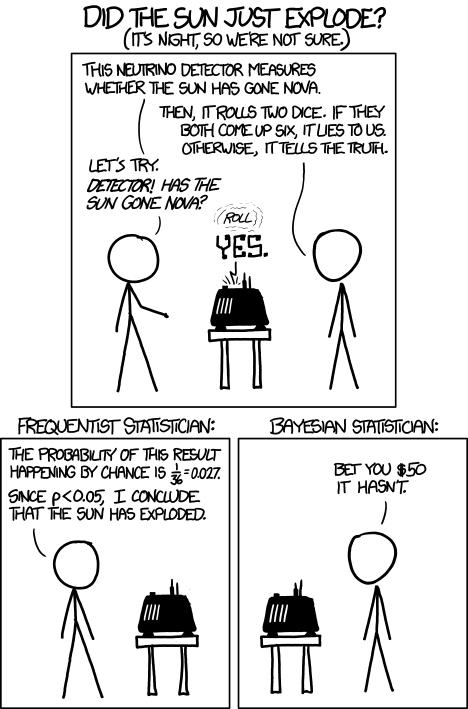
First, Bayes' theorem is highly dependent on prior estimates and tests.  There is a school of statistics, usually called 'frequentist', which defines probability in terms of the frequency of an event in a large number of tests.  According to frequentists, probability doesn't refer to prior probabilities.  The assumption here is that there is a correct probability which can be found through a large enough sample size.  For Bayes, it's probabilities all the way down.  Any probability is based on prior estimates, which were based on prior estimates, etc.


If you don't get it, don't feel bad.  Try here.


Bayes' theorem also forces us to take heed of the possibility of false positives.  No test is 100% accurate.  For example, if a steroids test is right 95% of the time, it might provide false readings 15% of the time.  Given the fact that 10% of athletes use steroids, we cannot say that a positive test gives us anything like 95% probability of steroid use.  Instead, it's more like 40%.

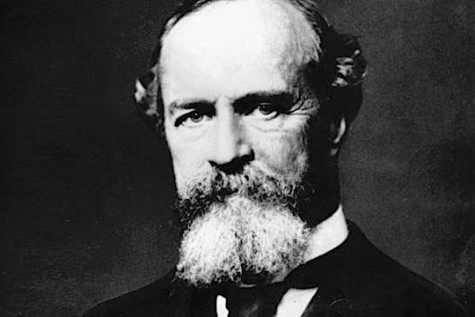
Philosophically, what's interesting about Bayes' theorem is it provides a method for evaluating new knowledge.  The psychologist and philosopher William James generalized the way we evaluate new experiences in the following way:
The process here is always the same. The individual has a stock of old opinions already, but he meets a new experience that puts them to a strain. Somebody contradicts them; or in a reflective moment he discovers that they contradict each other; or he hears of facts with which they are incompatible; or desires arise in him which they cease to satisfy. The result is an inward trouble to which his mind till then had been a stranger, and from which he seeks to escape by modifying his previous mass of opinions. He saves as much of it as he can, for in this matter of belief we are all extreme conservatives. So he tries to change first this opinion, and then that (for they resist change very variously), until at last some new idea comes up which he can graft upon the ancient stock with a minimum of disturbance of the latter, some idea that mediates between the stock and the new experience and runs them into one another most felicitously and expediently. 

James here is describing the everyday process of learning new information.  But, as James knew better than anyone, we don't always do this well.  Sometimes we don't think about false positives; sometimes we want to believe things that are too good to be true; and sometimes we get caught up in the present moment and forget about past experience.

Even if you don't work out the probabilities every single time you learn something troubling to your understanding of the world, understanding Bayes' theorem can still be helpful.  At the very least, it warns us about making rash decisions when we learn something surprising.  Silver believes that if we all thought a bit more probabilistically about the world, it might be a better place.  We would understand the uncertainties of our forecasts and anticipate exceptions to our beliefs.  It's worth a shot, I guess.

Sunday, January 6, 2013

You're Not That Smart

I'm used to feeling confused.  This is probably because of all the philosophy I've read.  Socrates said that the only thing he knew for sure was that he didn't know anything.  And nothing will make you more confused faster than dipping into a book by a German philosopher like Hegel or Heidegger.  Philosophy is all about getting comfortable with being confused.  This confusion is different from that which you might experience in a science class--if you're confused there, you simply need to turn to the next page or work through the homework.  Philosophy is fundamentally confusing, because no one has the answers to the Big Questions.

You might wonder what possible value being confused could have.  Philosophy majors have trouble justifying "what are they going to do with that."  The funny thing is that philosophy majors do better on standardized tests than any other majors.  They don't make as much money at the beginning of their career, but they tend to make more than other non-engineering majors later in life.  And philosophers pick up difficult fields like computer programming very quickly.  Perhaps there is something to being confused.

One of the main lessons I take from Nate Silver's new book is that there are many areas in which people think they are smarter than they really are.  Take poker, for example.  For a brief period of time in the early 2000's, Silver was a professional poker player.  Because of the poker boom, there were a lot of suckers that better players like him could thrive on.  The problem is that the skill set required to play poker follows a Pareto principle, or an 80-20 rule.  That is, with 20% effort, you can make the same decisions as the best players 80% of the time.  (Silver says: learn the probabilities, fold when your cards aren't good, and make some attempt to project what other players have).  It takes an incredible amount of effort to become very good.  So when the poker boom turned to bust, it suddenly became very difficult for average players to make any money.

Because of the amount of chance involved and our bias towards ourselves, it is nigh impossible to be objective about our own poker skills.  Most people who stick with poker start out doing very well--otherwise they would just give it up.  When they start to do badly, it could be the result of chance or their lack of skill.  Few have the patience to stick around and find out.

People also delude themselves on a habitual basis when it comes to investing.  Everyone thinks they have a rule to predict the market, or that their broker does.  Henry Blodget, CEO of Business Insider says: “‘Everybody thinks they have this supersmart mutual fund manager. He went to Harvard and has been doing it for twenty-five years. How can he not be smart enough to beat the market? The answer is: Because there are nine million of him and they all have a fifty-million-dollar budget and computers that are collocated in the New York Stock Exchange. How can you possible beat that?’”  No one seems to believe it, but there is no statistically significant relationship between a fund's performance one year and the next.  (Daniel Kahneman has a great explanation of this blindness).

Silver shows that a foolproof forecasting strategy is not enough, since transaction costs may eat up your earnings.  Furthermore, even if your strategy is sound, most people are psychologically unable to diverge from the herd to buy when everyone else is selling.  His advice is to follow the 80-20 rule and stick with indexed funds.  80% of the time, they're going to do as well as the very best traders could.  If you've come up with a set of heuristics to 'beat the market', you're probably kidding yourself. 

I recently took a Finance course through Venture-Lab.  Though the class was difficult and I was often confused, it was taught as if markets could be predicted with mathematical precision.  (The professor teaches in Stanford's school of Management Science and Engineering, after all!).  The implication was that if you're not making correct predictions about future returns, you just need a more complex equation.  If you can do the math, you're guaranteed to have an exciting and profitable career.  I don't buy it.

I'm more amenable to Silver's philosophy.  If you have good analytic skills, he says, look for the fields where the smart people are not flocking.  Wall Street is already flooded by ivy leaguers.  What are your chances of making it big?  Silver admits that he was lucky to get into baseball statistics, poker, and political prediction before the fields were dried up.  Look where it got him.  Rather than falling for any get-rich-quick schemes predicated on certainty, I'll stick with Socrates.

Thursday, November 8, 2012

The Information

I've been thinking about information.

  • Information is not about knowledge, nor wisdom. It has no claim to truth. Socrates never talked about information.
  • Information can be measured. For example, 11111111 has less information than 10010010.
  • The amount of information something has is called its entropy. An exploding star has a great deal of information. 2piR does not.
  • Information is not the same as language. A random set of a million bits will have more information than this sentence.
  • Nonetheless, information is about communication. It is an abstraction of the building blocks used to communicate meaning, but information itself conveys no meaning.

Claude Shannon invented the field of information theory when he figured out that boolean algebra could be implemented using electronics, and that signals transmitted and stored using such algebra could be used to convey any message.

Information was such a bizarre concept that early information theorists often had to remind themselves that they were not talking about knowledge. They were talking about messages, data.

Data is growing at a near-exponential rate. Are meaning and truth? Not necessarily. In fact, the more information we have, the more work we have to do to determine the meaning from the message.

As I've said before, the history of human progress is also the history of abstraction. Abstraction is what separates physics from the physical world and art from the phenomenal world. But it's a strange thing to abstract from ideas themselves. What is the abstraction of abstraction? Information.

For more hard thoughts, see James Gleick's The Information.

Saturday, June 23, 2012

What Technology Wants?

(The last few posts have been inspired by Kelly's book.  This is a proper review of the main argument.)

Thinking about technology is hard. The problems begin with the very word 'technology.' The Greek word techne, from which our term derives, meant 'craftmanship' or 'art', as opposed to episteme, which meant something like scientific knowledge. Broadly speaking, the difference is between knowledge which is used and knowledge which is contemplated in its logical beauty.

Most people don't share the Ancient Greek view of science as mere contemplation. Almost every field involves knowledge about how to do something and has an element that can only come from experience. Consider law, music, plumbing, politics, or, of course, scientific research. These are all ways of remaking the world and are thus 'technologies', not systems of pure reason.

Kevin Kelly embraces this broad understanding of technology and tries to make some prescriptions based upon it. Even though apps are very different from laws or chords, technologies are enablers. They create options for us. Think how many fewer options there were for people to lead fulfilling lives 100 or more years ago. More technologies mean more opportunities for self-actualization. The system of music of the medieval period, for instance, sounds as constrained to our ears as the kinds of work available actually were.

Kelly's purpose is to outline some of the traits of technologies that we should seek to foster, such as complexity, ubiquity, diversity, specialization, and evolvability. Such technologies would create more options for more people. They would also help continue the incredible rate of progress of options-creation we've seen in the last few centuries.

Though he provides a number of interesting ideas along the way, I find Kelly's analysis very unsatisfying. The main difficulty is the all-encompassing nature of what he seeks to understand and proscribe. You can see this in the way he wants to talk about technology in broad terms like art and law, while his proscriptions seem most applicable to the gadgets we're most familiar with calling 'technology.'

Furthermore, Kelly is interested in arguing that there is an inevitable march of progress to technology. He describes the 'ratcheting effect' of science which builds upon itself as an example. We can't stand in the way of progress. All we can hope to do is ally ourselves with it. Any impediments to this progress, or everyday fluctuations in this march are, as he says, 'random noise' which do not figure into the total.

I would argue, however, that such 'random noise' is exactly what we need to pay attention to. Even if it is true that all human creation is technology, and all technology can be understood in terms of the options they provide for us, there is still no reason to believe that even 51% of options are good--which is what Kelly suggests--so that, on the whole, we are better off. This is so vague as to be almost meaningless.

I applaud the effort to find criteria for judging technology, as there are few people even thinking in these terms. However, I find it very hard to accept that all technology can be judged on the same bases, even if we're only talking about gadgets. Just because a few people want the option to do something doesn't mean that this is good.

Rather than taking Kelly's book at face value, perhaps what's most inspiring is the personal example of adoption Kelly outlines when talking about himself. Though he helped found Wired magazine, he is no technophile. He doesn't own a TV or buy every new gadget that comes out, but rather tries to evaluate all technologies within the value system he and his family have developed. This is a model that we could all learn from.

Sunday, April 1, 2012

Accounting and Thermodynamics

Predator-vision
A few years ago, I rented a very cheap house in a very cold part of the country. I wanted someplace big to play my drums, but I didn't realize what kind of heating bills I would get in the winter. I ended up keeping the house at 40 degrees Fahrenheit, using space heaters, and freezing a few pipes.

Besides earning a story to tell, I also learned how to see rates of flow. I was suddenly able to see the various heat sources and sinks in my house, with vectors of various strengths showing the direction and rates of flow. Unconsciously, I had always thought of heat as being a property of a room or building, but I now saw heating the way physicists see it.

Locke-vision
Such paradigm shifts, which overlay your present view of the world with a broader experience, are not uncommon. I always enjoyed studying geology, since it allows you to see the seemingly-fixed landscape as a fluid process and to see human activity from the perspective of the Earth. For thousands of years, astrology let people interpret ordinary events through the lens of the cosmos.

One of the most natural ways of seeing the world is as a collection of things with properties. This view was best put down on paper by modern philosophers like John Locke. They went back and forth about how subjective 'secondary' qualities like color and taste could be known to be true to the 'primary' essence of a thing, but they never questioned the atomistic model of the universe. This was only natural when the physics of the day characterized the interactions of the universe by analogy to billiard balls.

I've been trying to get my head around some hard accounting problems, and I realized that my problem was thinking of accounts as things with properties. It is correct, in a sense, to describe accounts as having a dollar amount. But is is more correct to think of them as part of a system of interconnected accounts with various directions and rates of flow, much like the heat in my cold house. This is because the value of an account is constantly changing, and because its changes are the direct result of transfers from other accounts. Even the cash in your wallet is not separate from this plumbing. I've begun to see the systems I build and maintain as part of the flow of the entire monetary system.

This flow is becoming particularly interesting with the growth of currency-less transactions like ACH. If you get direct deposit, you use ACH. In the future, there will be no paper or coin currency. We'll simply transfer funds between accounts with smartphones or other devices. There are many fascinating consequences of the death of currency. For instance, if governments do not have to pay the cost of printing money, the cost of transacting will be borne by retailers in the form of transaction fees. Someone will also need to bear the cost of information theft when you lose your phone.

$0.01, spent at all places and times
But I have a really crazy thought.  If money becomes infinitely liquid, won't its velocity increase infinitely, thus increasing the money supply infinitely, and raising the cost of everything infinitely? I wonder if the the laws of thermodynamics will continue to hold as currency becomes digitized. With real-time web services and other technologies that take us away from daily batch file ETL common to financial systems, we increase the liquidity of money with consequences that are not yet clear. Instead of rates of flow, we may have currency that is in all accounts at all times, much like the Heart of Gold's Infinite Improbability Drive. But I suppose I shouldn't borrow serious thoughts from Douglas Addams.

Sunday, March 25, 2012

Is Statistics the Key to the Soul?

I've been brushing up on my statistics, since I was convinced I didn't learn anything practical in my two semesters of calculus-based 'statistics.' It turns out that I did learn a thing or two besides how to integrate Poisson distributions. What struck me most about statistics this time around is its objective power. I'm coming to believe that the history of human progress is the history of increasing abstraction--from markets, which abstract price from use value; to language, which substitutes abstract signs for the world's infinitude; to representative governments, which generate the will of the people from voter preferences; to information theory, which abstracts universally-understood 0's and 1's from meaning. Each new power of abstraction provides a new tool for humans to shape the world.

Borges' library has been found!
Of course, abstraction has its price. There's always something lost in the process of abstraction. Jorge Luis Borges (the author of the story for which this blog is named) writes at length about the experience of hitting the limits of abstraction, the real world. For example, if all knowledge was written down, we could never know anything, since we'd spend all our time sifting through an infinite number of books contained in an infinitely-forking library. If we remembered every experience we had in its minute detail, we'd never be able to live in the present or learn from the past. Similarly, the will of the minority loses out to the will of the majority, and statistics can never replicate lived experience.

Processes of abstraction can also be fetishized for their own sake. The operations of markets, the intricacies of language, the back-and-forth of the political process, the elegance of algorithms, or the endless march of statistical analyses are all deep, deep rabbit holes from which many never return. There's a point at which every student of philosophy--having been convinced by philosopher after philosopher--decides that it impossible to determine who is right and resolves, if only for a short time, to study philosophy solely for the beauty of its systems. There's even a perverse pleasure in the counter-intuitive nature of abstract thought, such as learning that rent control makes rent higher or that work = 0 when something is moved a great distance before returning to its origin.

One of the most interesting characteristics of processes of abstraction are the ambiguities inherent in them. Since abstractions miss something real, they are always equivocations. This happens in language when we can't decide what to call something. Is Pluto a planet or an asteroid? In statistics, ambiguity appears in the form of studies that contradict each other. Are eggs good for you or not, for chrissake? Statistical analyses are objective and help us overcome the biases of our thought processes, such as when they show us the irrationality of our fear of flying, sharks, and home invasion. But it's easy to slice the world into irreconcilable parts when those parts are so small in comparison to the actual, ever-changing world. Scientists often can't reproduce the results of their experiments. This means that either 1) the laws or regularities of the world are not the same now as they were at the time of the experiment or 2) there is some variable which they have not accounted for. And there are always variables that are not accounted for.

With the growing trend of personal data collection, from activity tracking to sleep monitoring to mental acuity quantification, we will soon be able to analyze ourselves with ever greater scrutiny. If you want to know exactly how far you've run in the last five years, you can do that. Does this make you a better runner? That is not clear, but the trend is. We'll soon be able to use the data mining techniques that advertisers like Google created on ourselves. In some ways, this is exciting. What better way to know thyself than with objective data? Conquering ourselves may be the next frontier of the powers of abstraction. But this path will be fraught with even greater dangers of experience lost, fetishization, and ambiguity.

Sunday, March 18, 2012

The Story

What about 'Knowledge of Philosophy'?

I recently read that there are only three interview questions:
  1. Can you do the job?
  2. Will you love the job?
  3. Can we tolerate working with you?
In the past, I haven't had a lot of trouble with these three. My problem is:
  1. What's with the PhD in philosophy?
There are plenty of reasons not to fret about this. I doubt my answer matters much given my ability to answer the other three. Plenty of people take a non-linear career path, and there are lots of reasons to get a PhD--it has helped me to get noticed, if nothing else. Finally, a PhD in, say, computer science probably wouldn't give me any more special knowledge than one in philosophy, because what I would have studied would have been so specific and so quickly dated. Still, the question comes up often enough in normal conversation that I'd like to be able to give a reason more interesting than 'broadening my intellectual horizons' and shorter than my dissertation. Here's my attempt.

A degree in engineering (and some experience in the field) shows you how to solve problems, but it doesn't provide much help in figuring out questions like 1) What should I solve? 2) What is it right to solve? At Penn State, the main recruiting industries were military. I knew that I didn't want to kill people, but I didn't know much besides that. I lacked direction, and the only guidance I got from my computer ethics class (Ayn Rand) wasn't particularly helpful. (She says: go do great things, but what were those things I should be doing?) My philosophy classes were more promising, but they really only whetted my appetite.

In grad school I focused on moral and political philosophy. That is, instead of trying to prove or disprove God's existence or understand how we can know anything, I was interested in: 1) What is the Good? and 2) What is the Just? These problems were particularly difficult because, like most non-fanatics, I didn't think there could be just one answer. But my moral intuitions gave me reason to suspect there had to be some kind of answer. It's that space between 1 and infinity that's tricky.

It took some work, but eventually I became a philosophical pragmatist. I realized that, like most philosophers today, I thought I had accepted that there was no Absolute Truth when I was really still hankering after It. Pragmatists have a good explanation of relativism without believing that whatever you think is the right thing to do. (If you're really interested, start here). You simply can't accept that there are multiple right answers and keep asking the same old questions, like 'What is the Good?' or 'What is the Just?'

James figured out a new way of thinking with an old name

Pragmatism involves bringing scientific thinking to all areas of life, including moral and political questions. What most people don't realize is that science has become relativistic in the 20th century. From Heisenberg's uncertainty principle to Godel's incompleteness theorem, scientists have stopped looking for absolute truths and now couch their hypotheses in terms of the highly-specific and reproducible experiments. One cannot extrapolate beyond those experiments for all situations and times. Brian Cox often says that there's no good reason to assume scientific 'laws' will hold for any amount of time--we simply find that they do so in many situations.

Pragmatism is important for thinking about technology in at least two ways: 1) It helps us reconcile morals with science. For example, if new technologies make the consequences of our actions very widespread, we must become more knowledgeable about them in order to realize our moral principals. 2) On a social scale, it shows us how to think about technology and the greater good. For instance, instead of thinking about technology as just a tool or as the savior of mankind, we should look at how some technologies help us solve certain collective action problems. In either case, the main point is to look at concrete problems and technologies, not technology, morality, or justice in general.

All this is very brief, but that's because it's what my blog is all about: applying principles to specific problems. I still tend towards the overly-philosophical side, but I'm getting there.

Sunday, February 19, 2012

A Parliament of Things

Technology is a scene of social struggle, a parliament of things on which civilizational alternatives contend.
--Andrew Feenberg
In the wake of CES, I've had a lot of conversations that go something like, "Have you seen the new X? It can do A, B, and C!"  Proponents list off the functionality that X can do, and haters point out what it cannot do (D, E, and F, which Y does). The conversation centers around a particular gadget and its abilities. Rarely does it enter into the sphere of what X should do.

When you start talking about possibility (should) rather than actuality (is), you quickly slide into the realm of philosophy. Many technophiles avoid philosophy due to a faith that technology will solve all problems--we just need more of it. Ignoring philosophy might seem to be the more realistic and safer thing to do. Socrates was, after all, condemned to death.

An early blog post
But this so-called 'realistic' viewpoint actually ignores how technology happens, and in two ways, according to Andrew Feenberg, a professor of philosophy at Simon Fraser University. First, technologies developed for one purpose are often used to do other things. That is, their meaning is socially determined. It's not hard to find examples of this. The architects of the Internet could never have guessed in the 60's what it would look like today. It's to their credit that their design could be repurposed in many ways, from lolcats to the Arab Spring. Similarly, Johannes Gutenberg, who simply wanted to spread the word of the bible with his invention of movable type, could not have dreamed of the social upheavals--including the Reformation and the French and American revolutions--made possible by the new printing press.

Second, people determine what technologies should be developed. Feenberg calls this the cultural horizon of technology. There is nothing inevitable about the course technology takes. If many technologies are developed to kill and exploit people--whether the atomic bomb or the ludicrously expensive F-35--that's because a small group of people and interests tend to decide what is researchable. If many technologies are developed to automate repetitive tasks, that is because of the price that we, as a society, put on efficiency. Hence the continuing importance of IT departments and the automation of manufacturing.

There are thus two ways that societies shape technology: in what gets researched and developed (their cultural horizon), and in how technologies are put to use (their social meaning). Both sides constitute the 'parliament of things', as Feenberg calls it (note: this is not the same as Latour's use of the same term). If we don't like our current technologies, we need to democratize the funding of research and have conversations about what kinds of technology we want. Funding for technology research typically occurs in two ways: through markets and through the government. Both are controlled by our votes, both literal and metaphorical. We also need to talk about the uses to which technologies are put, such as by enforcing norms or changing social practices.

$1 trillion for a plane

If this all sounds a bit idealistic, consider a couple of examples of the democratizing of technology. Feenberg notes that many regulations which were bitterly fought eventually came to be seen as obvious, including child labor laws in turn of the century America. It was argued that the inefficiencies labor laws would introduce in the labor system would be prohibitively costly, yet it's hard to imagine what the 20th century would have looked like without them.

And, of course, the government is not the only tool we can use to change the course of technology. In the last ten years, journalism has raised awareness about 'cyberbullying', so that parents can talk to their children and teachers to their students about appropriate uses of social media. Social media can be regulated by governments, as in the case of recent changes to privacy law, but they can also be monitored by societies themselves.

So, what do you want technology to do for you?

Links
-Andrew Feenberg's Ten Paradoxes of Technology

Sunday, February 5, 2012

From My Cold, Dead Hands!

Do guns kill people or do people kill people? A famous NRA spokesperson might say that a gun is just one of many tools a killer could use--the problem is not guns, but people. Educate people, and you'll solve the problem. Gun control supporters, on the other hand, argue that putting a gun into someone's hands changes them. It makes them do things they wouldn't do otherwise. If you remove access to guns, you'll remove the main cause of violent death.

Whether or not you are politically inclined, you've probably had a similar discussion that centered around a technology like firearms. For example, are hackers social deviants who just happen to create malware and viruses? Or does the internet and the availability of free software tools create malevolent coders? Similarly, do smartphones make people terrible bores at social events, or do they provide anti-social people an excuse to opt out?  Finally, and in a more positive vein, are people smarter today, or do we just have better technologies, like Wikipedia?

These questions come down to the same thing: What is the cause of an action? Is it the technology that is a means to the action (this might be called the materialist explanation)? Or is it a person's intentions or ability to do something (this might be called the sociological explanation)? Should we blame things or people?

Maybe these questions are not framed quite right. Sociologist Bruno Latour helps us break out of these nature/nurture debates with what is called Actor-Network Theory. According to Latour, both a gun and a person are actors or causes. (Since it seems strange to call an object an actor, he uses the word 'actant.') A gun + a person is a new actor. A person doesn't simply use a gun, nor does the gun simply alter a person. The technology creates new possibilities for a person, but a person creates new possibilities for a gun.

Of course, all advanced technologies involve a chain or network of actants. In the case of guns, this might include political states ordering guns and determining who has access to them, factory workers manufacturing guns, and users of guns, such as armies. Without a network like this, guns could not make sense. Latour says, "747's don't fly--airlines do." That is, a 747 would be worthless without a network of thousands of people, concepts, and things.

Furthermore, any component of a technological device (including the device itself as a whole) can be treated either as a black box or as an almost infinite chain or network of actants. For instance, computers involve software, wetware, and hardware. Hardware involves hardware components like hard drives. Hard drives involve other components, like magnetic tape. Magnetic tape implicates the historical development of manufacturing processes, the logical abstractions of information theory, and the decisions of many decentralized people, including programmers, users, and business people. When talking about the technology of a speed bump, Latour says that it's "ultimately not made of matter; it is full of engineers and chancellors and lawmakers, commingling their wills and their story lines with those of gravel, concrete, paint, and standard calculations."

The meaning 'obey the speed limit' is translated into 'protect your car's suspension' by the technology of the speed bump

So, what is to blame? People or guns? Latour's answer is: the entire network of actants (guns, gun owners, engineers, and manufacturers), which are themselves products of years of experimentation and learning. Unfortunately, this answer is probably not very satisfying to political junkies. It cautions us to be careful about what we develop, but what about what has already been developed? It is much harder to change an existing network than the two proposed solutions: education or the banning of guns.

Sunday, January 8, 2012

"I'm about a 7"

Many people (and sociologists!) have noticed that, when you ask someone to rate themselves on a scale of 1 to 10, they give themselves a 7 typically. It doesn't matter what it is.  For example, if you ask someone to rate how well they drive, they'll say 7. I've been in interviews where candidates are asked to evaluate their SQL skills, for instance, on a scale from 1 to 10. Their answer? "I'm about a 7."

 If everyone says they're a 7, one inference to make is that people are not objective when it comes to things close to them, like their children or their own skills. This is sometimes called the 'Lake Wobegon Effect', named after Garrison Keillor's fictional hometown in which 'all children are above average'. You can't trust people to rate themselves, it is inferred. That's why driver's tests, SATs, and other methods of evaluation were invented.

 But another, often-overlooked inference is that people value different things differently. You might value driving fast, while I might value driving safely, or in a way that shows off my car, or in a way that is fuel efficient, or in a way that doesn't remind me of a terrible accident I once had. Since driving can be many things to many people, they answer in terms of what driving means to them when asked abstract questions like, "How good are you at driving?" The reason people are a 7 at SQL is that they know enough to be able to do their jobs, but they could always learn more. There is no absolute standard of SQL-ness that they could rate themselves against. They're a 7 at writing reports, performance tuning, deploying code, or whatever else their (previous) job entails.

9 for fight scenes; 2 for plot
I think this second conclusion is more interesting and more useful. It has consequences for the ways we assess skills, since we never care about someone's skill in general--whatever that might mean--but rather their ability to perform a certain job. They should be asked questions particular to that job, and, if possible, they should demonstrate those specific skills in interviews.

The realization that people value different things differently is also important in everyday life. We'd have a lot fewer arguments about whether or not someone is a good driver, teacher, or cook, or whether or not something is a good movie. Or, at the very least, we'd have more concrete arguments.

And, maybe sociologists would ask us less bizarre questions.

Sunday, December 11, 2011

Technology and Collective Problem-Solving

"Technology" signifies all the intelligent techniques by which the energies of nature and man are directed and used in satisfaction of human needs; it cannot be limited to a few outer and comparatively mechanical forms.
--John Dewey
In a previous post, I explained how many philosophers, including Heidegger and Marcuse, see a rift between ethical reflection and technology. They worry that the means-ends thinking at the heart of technology can cause us to ignore other kinds of reflection--especially about who we want to be, what we hold to be just, and how we can lead more meaningful lives.

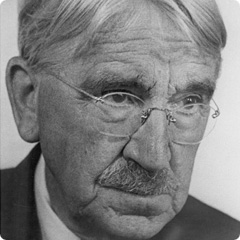
There is obviously a difference between painting a picture and developing a manufacturing plant to make paints and brushes, but what's wrong with solving problems? Is it really so dangerous as philosophers--who aren't typically known for being technologists--seem to think? John Dewey says no, arguing that all inquiry has a technological component insofar as it is meant to solve problems. If moral inquiry helps us solve problems, it's as technological as lasers and airplanes are. Theories are just tools for solving problems.

Understanding technology as problem-solving may seem impossibly vague, but it's actually very powerful. Whenever considering a new gadget, theory, or way of doing things, Dewey suggests we ask: what is the problem this is meant to solve? Remarkably, many new products don't seem aimed at solving any problems, or at least not any serious ones.

What about the problem of collective decision-making? Humans have created two lasting technologies for this purpose: representative governments and markets. Governments are good at ensuring certain behaviors that its people think should be ensured. They define and enforce justice, including the means of determining what justice is. This wasn't always the case and took many years of trial and error. Life used to be filled with a lot more anxiety, because the world was so much more unpredictable, and the means of determining fairness were uncertain.

Althingi, where Icelanders have solved problems since 930 CE

Governments, however, can only solve certain problems. They're bad at picking market winners, for example, and they're slow to react to change. They are good at prohibiting certain behaviors, but it's hard for them to make citizens moral, healthy, intelligent, or cultured. As Cass Sunstein argues in his book Nudge, the best governments may be able to do is incentivize certain behaviors so that people will make the right choices on their own.

Markets, on the other hand, provide a highly responsive way of determining what people value and what should be produced. As Friedrich Hayek recognized, markets aggregate people's individual choices and values and thus collectivize intelligence in a very efficient manner. Markets will always have the input of more people than governments as well as higher levels of participation. And, since people often know what they want better than 'experts,' markets can be more rational than governments.

Unfortunately, many things cannot be quantified in dollar values, such as the environment, health, or justice. We can adjust markets so that they take hidden costs into account, as cap-and-trade systems do, but these work best when you have a metric that can be easily tied to cost. Another criticism of markets is that people do not always act rationally, as Daniel Kahneman and other behavioral economists have shown. Even if we know what we want, we can't be sure to act accordingly.

Given the limitations of governments and markets, Deweyans turn to small groups for salvation. There are many interesting examples of small-scale collective problems solving, such as the rebirth of Pittsburgh or river management in Mexico, but it's hard to see how such solutions will scale. As our interactions become ever more global, we need globalized methods of collective decision making.


For these reasons, Clay Shirky and other technologists point to the internet as a possible third way of making intelligent choices collectively. It's not enough to say that the internet connects people. The idea of the internet as a 'Global Village' has become a joke, as new technologies help us filter each other out like never before. What Shirky points to is the way the internet lowers barriers to participation. Shirky's poster child is Wikipedia, which, like most internet phenomena, displays a long tail of participation. Many people work together, though the vast majority only contribute a little.

Lowering barriers is great, but it is probably not enough if we are to find a third way to compete with governments and markets. Can new technologies help us better solve collective problems? The question becomes ever more pressing as big players like Google, Microsoft, and Facebook become ever bigger and structure the ways we interact more and more. Not being evil is not the same thing as providing venues for increasing collective intelligence. What other problems should we be trying to solve?

Sunday, November 13, 2011

Some Questions Concerning Technology

After you work with computers for a while, you stop asking what acronyms stand for if you know what's good for you. The answer is always long and pointless. SQL is hardly a Structured Query Language. GNU is not exactly Not Unix. And Microsoft comes up with a new three-letter acronym (TLA) every week. Luckily, most companies have turned their IT departments into just Technology departments, so we have only one letter to worry about. Though it may be a pursuit both long and pointless, I've been thinking about what technology really is.

There are two standard ways of understanding technology. One is that it's the essentially human activity. Monkeys use sticks and bees build nests, but humans take tool-making to an unprecedented degree due to their clever brains, opposable thumbs, and upright posture. Various intellectual revolutions have taken humans farther and farther from their natural state.


Another way of understanding technology is as applied science. Wikipedia says technology is "the making, usage, and knowledge of tools, machines, techniques, crafts, systems or methods of organization in order to solve a problem or perform a specific function." While science can be pursued for its own sake and without a clear view of its potential application, technology is the use of knowledge for specified ends.

There are a few problems with these definitions. For example, if technology is just part of what we are, then why do people often rail against technology, as happened in the industrial revolution, or after Hiroshima, or in today's world of hyper-connectedness? If you say technology is "natural" or "human", then it's hard to explain why some technology is good and some technology is bad.

Similarly, if technology is just problem-solving, then why does it have so many unforeseen effects? It often seems that new technologies create as many problems as they solve. In The Social Network, Sean Parker says they can't monetize Facebook because they don't even know what it is yet. Technologies as simple as email have changed they way we live--they don't just scratch an itch.

In a characteristically gerund-filled essay, The Question Concerning Technology (1954), Martin Heidegger tries to overcome these obstacles and get at the essence of technology. First, he distinguishes between the production of technological artifacts and the way of relating to things that makes their production possible. It is only when humans treat things (e.g., the sun, information, and even other humans) as means to an end that we can create technological solutions. For example, when a river is understood as a means to an end, it can be dammed to produce power. It can be understood in other ways, (e.g., a thing of beauty, a shape, a manifestation of God, etc.), but such thinking doesn't help solve problems and is thus not technological. Heidegger argues that technology, or technological means-ends thinking, is what makes modern science possible, not the other way around.

Neither science nor technology are necessarily bad things, but it's easy to take means-ends thinking as the only appropriate way of relating to the world around us. Today, as Heidegger points out, it's hard to take seriously Aristotle's four causes (material, teleological, formal, and efficient), since we are so used to thinking in terms of efficient or means-ends causality. On this model, we think we can predict the future with exactitude (given enough information, all things being equal, etc.), and even God becomes merely a watchmaker who set off the chain of causes that is the universe.

So if technology isn't a set of gadgets or the things people do to make those gadgets, if it's a way thinking that often occludes other ways of thinking, what then? It's worth noting that this definition solves the problems with the other conceptions of technology defined above, since technology is not just something humans do--it's one of many relationships we can have with other people and things. We might be able to judge the new possibilities technology makes possible, but not technology as such.

Most importantly, Heidegger's understanding of technology as means-ends thinking points to the need for other ways of thinking--aesthetic, cultural, social, ecological, religious, political, ethical, philosophical, kinesthetic, you name it. I'm often turned off by tech news, because it reinforces the culture of buying the latest disposable gadget instead of the development of truly important solutions. Rather than fleeing from technology as some Luddites do, we need to imbue technology with the real world technologists often ignore. I like my smartphone, but it's a far cry from the future envisioned by the prognosticators of the 1950's.

Links:
-Heidegger's essay in a more-or-less readable format
-Herbert Marcuse's essay on the political ramifications of ubiquitous means-ends thinking
Related Posts Plugin for WordPress, Blogger...