Showing posts with label Seven Databases in Seven Weeks. Show all posts

Sunday, October 14, 2012

HBase: A Column-Family Store

The next NoSQL database in my whirlwind tour is Apache HBase, a column-oriented database. Riak was a simple key-value database, which mapped an object it knew nothing about to a bucket/key combination. Its job was just to make sure the data was replicated consistently in a highly fault-tolerant manner. HBase schemas, on the other hand, are made up of tables, which are dictionaries of dictionaries. It gives you more granularity and schema control, but it's still dumb about the values of its key-value pairs.

For SQL developers, HBase terminology will not make much sense at first. The large objects are tables, which are made up of key-value pairs consisting of row keys and column families. The column families are, in turn, collections of key value pairs. A table is not a group of relations, nor are there any guarantees that one row will look much like another.

An HBase table

The value of this system is that you get another layer of granularity over a key-value store like Riak. You have a bunch of stuff (a table of rows), which has a couple broad characteristics (a row of column families). Listen, these NoSQL database systems are not all that different from each other. Which one is right for you will depend upon 1) your other applications, 2) your size needs, 3) your performance needs, and 4) your fault-tolerance needs.

For example, HBase cannot read until one client succeeds in writing to all replicated instances. Riak can be tweaked so that writes are successful when only one node has been written to, so it should be faster (though it's hard to find any data on these things--you'll have to do the POC yourself). HBase is best when you have a lot of data and need to run MapReduce. Riak is right if you need 99.999% uptime.

For me personally, HBase was a pain in the ass to set up. I'm not a Linux pro, and HBase isn't really meant to be run in a single instance on a crappy laptop, but this was a real turnoff. MongoDB, Riak, and PostgreSQL were all pieces of cake to set up. So why do it?

One reason is that HBase is part of an ecosystem of tried-and-tested enterprise applications, like the Hadoop Distributed File System and the query language Hive. Its users include Facebook, Twitter, and Yahoo! (Google uses its own BigTable.) There's a large community of users to go to with questions.

Still, HBase has the flavor of many Open Source systems that grew out of a matter of necessity of scaling fast on commodity hardware. I'll be interested to see what Microsoft does with Hadoop and HBase. Call me a Microsoft fan-boy, but I think their integration of technologies is often very good, and it takes time to work out the kinks in a new platform. The first iPhone was a piece of junk. It takes a few iterations for a technology to mature and solve the problems it's designed to solve.

Links:
-Check out this nice comparison of Cassandra, MongoDB, CouchDB, Redis, Riak, HBase, Membase, and Neo4j

Sunday, September 9, 2012

Mapreduce and Key-Value Systems

I've been playing around with Riak (ree-ack), my first foray into NoSQL, and it's been a lot of fun. Riak is an open source implementation of Amazon's DynamoDB. It's a web-ready key-value store that scales easily. And it's a whole different world from RDBMS's. Basho has a great tutorial for getting started.

If you're a database guy like me, you're probably wondering what you can do with a key-value store. Using key-value tables is a SQL anti-pattern. Even if you get performance and scalability (which I'll discuss in an upcoming post), it's hard to see how you could do any interesting queries with a key-value system.

One thing to note is that a file system is basically a key-value store. The key is the file name and the value is the contents of the file. You can do searches on file systems, but you can't really do much querying. If your data needs are more like a file system than complex analytics, a key-value store might be right for you.

I also finally learned what the MapReduce algorithmic framework does. You may have heard of MapReduce (amongst many other new technologies) in connection with Hadoop. MapReduce will probably go down in history as one of Google's greatest contributions to computer science (along with the PageRank algorithm).

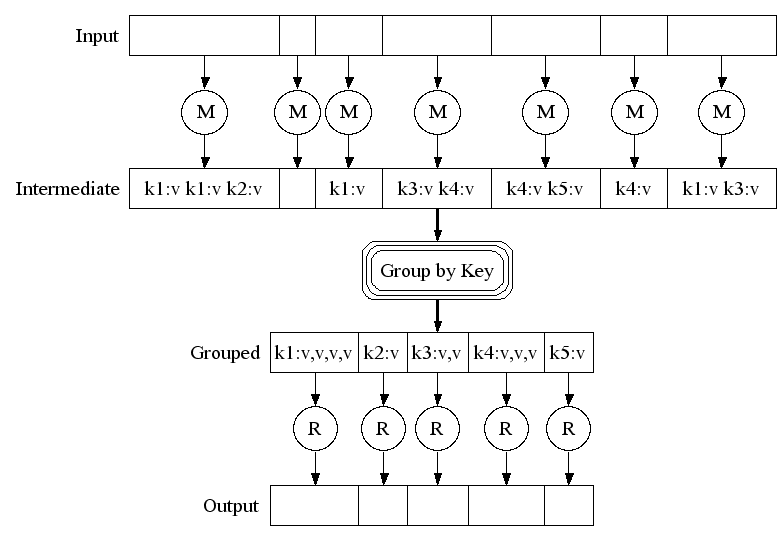
MapReduce is inspired by a functional language, LISP.  The idea is simple: take the algorithm to the data. In a highly distributed and scalable system, it's not feasible to move data to a processor in order to aggregate and slice it. You have to do any processing in-place. The way to do this is to map your keys to some kind of broader category and then run a reduce algorithm over the mapped data to pick out only the information you need.


For example, let's say your key-value store contains documents, and you want to count the number of documents beginning with the letter 'X' that contain the word 'tibialoconcupiscent'.  In this case, you would map all documents with a key like 'x*', such as 'xerophagy.pdf'.  Your reduction algorithm would simply return 1 for every case of the word and 0 otherwise. This reduction could be run on each server, a group of servers, and then all servers, returning a single (probably small) number.

This framework may seem limited, and it is. Key-value systems just aren't great for complex querying. One reason SQL has been so popular is that it allows for unlimited combinations of queries. You're limited in the ways you store data, and you have to wait for the system to write the data to disk in order to ensure consistency, but you can read the data in lots of interesting ways. That's why it's called a Structured Query Language.

(Riak does let you do some more interesting things because you can create links between different keys that define any kind of relationship between them. These links are just metadata. You can MapReduce across links, but the basic idea is the same.)

Now, where would I use Riak? There are a good number of production users already. I would think it would be best used in systems that don't require a lot of complex querying or complex data types. For instance, it could store webpages, messages, or other content. Unless you have a huge amount of data or require very fast writes, it's probably not necessary. But if you're looking to grow fast, it might be the right choice.
Related Posts Plugin for WordPress, Blogger...