Showing posts with label Google. Show all posts

Sunday, September 23, 2012

Algorithms, AI, and Emergence

The story about why Google overtook AltaVista is a fascinating one. Up until Google, there were two ways of accessing web pages. The first was Yahoo!'s portal approach, in which a single authority determines the web pages worth viewing, and you trust the experts to have done their work. You want to read sports news? Go to Yahoo! and then the Sports category.  Simple.

Lightning fast!
The obvious problem is that the experts at Yahoo! might have missed something. For this reason, I always preferred AltaVista (or WebCrawler, before that), which used an indexing approach, similar to an index in the back of a book. AltaVista used simple programs to search for key terms in a page's text and metadata and then aggregate that data in a way that later could be easily matched and ranked according to search terms you fed it.

AltaVista was better than the alternatives for a few years, but it had trouble determining relevance. If you're searching for a recipe with certain ingredients, you don't want just any recipe; you want the best recipe. If you want to read about last night's game, you don't want just anyone's commentary; you want the best commentary.

Enter Google's PageRank algorithm. PageRank takes authority into account, like Yahoo!, but it doesn't require a single source of information, like AltaVista. Pages that have more links to them are ranked higher than ones that don't. And the pages that link to these pages give an even higher ranking if many pages link to them. PageRank lets you find what the most important people are talking about.
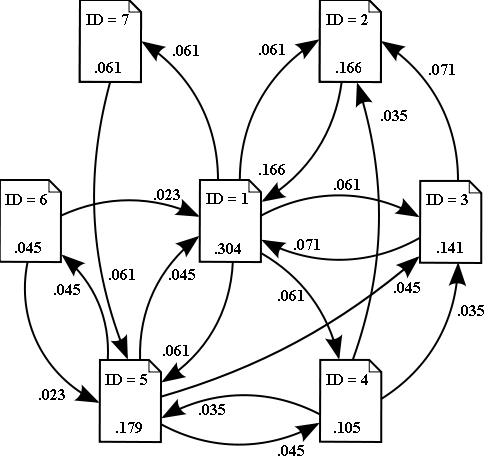
.304 (at the center) is the highest page rank in this contrived example

It's a bit more complicated than this, but what is revolutionary here (and I use the term revolutionary sparingly, unlike, ahem, Apple) is that Google's algorithm did not try to reproduce the intelligence of the web that was already out there. Instead, it tried to capitalize on the accumulated intelligence of millions of individuals who had made a simple choice: to link to or not link.

Linking is a binary action that, when accumulated into a large network of linked pages, allows for an emergent kind of intelligence. Emergence happens when a simple set of rules add up to something greater than their parts. Ants, for example, are very stupid individually, but when they signal to each other using pheromonic rules that have evolved, some very complex behavior emerges. Similarly, neurons in themselves have no intelligence. They can either fire or not. But when you have a few hundred billion of them, you're on your way to self-consciousness. Markets too display emergent phenomena when the buying and selling of millions of people shape the direction of societies.

PageRank is just one of a few algorithms that have begun to capitalize on emergence. For decades, it was assumed that language translation software would have to know the rules of grammar of the source and destination language in order to decode and encode meaning appropriately. This was a miserable failure. The success of modern translation algorithms is that they use statistics to compare millions of existing translated documents. The algorithm knows that, for example, it has seen 'Je suis' much more frequently than 'Je es'.  It doesn't need to know anything about grammatical rules.

An ant fugue
The problem with algorithms like PageRank is that they are parasitic upon an existing emergent system, whether it is a network of linked pages or a network of translations. The algorithms themselves are not emergent. They require human maintenance and tweaking, and they lead to people gaming the system. PageRank spawned web spam, in which people post links to sites in order to increase their ranking. This is why it's now only one of 200 or so indicators of rank for Google. The whole point of Gödel, Escher, Bach is that intelligence cannot be decomposable into a set of rules. Algorithms like PageRank are still just that.

While we've made some tremendous advances in machine learning by fitting algorithms to emergent systems, the future of AI can't be algorithmic. It can't be only a set of rules. But it might be a set of rules that, when used in aggregate, lead to emergent and artificial intelligence. What set of rules could be this flexible? Perhaps only the binary links of neural networks.

Sunday, April 8, 2012

Do Technologies Have Politics?

I've been exploring the idea that technology isn't just a collection of things which can be used interchangeably for either good or ill. Technologies shape the world and the range of choices we have. For example, in my last post, I suggested that real-time technologies may have effects for the ways we do finance. Our question today is: if technologies can shape financial decisions, can they shape politics as well?

Riot!
It's one thing to say that technologies are used for political ends and another to say that technology is political. The latter is Langdon Winner's claim. If politics is about power and authority, then at least some technologies are political if they embody, define, or exert the power of some people over others.

Technologies are obviously political when they are used as tools of control. It is often feared that new computer technologies will allow governments to spy on people in order to control illegal activities. But forms of control can take much subtler forms. For example, when Robert Moses designed many public works in New York City in the mid 20th century, he designed them so that people could not get to them via public transportation. The overpasses he constructed have a clearance of only 9 feet--far too low for buses and those who would ride them to get to Jones Beach. Similarly, many people don't realize that the grand boulevards of Paris were designed by Baron Haussmann in the mid 19th century as a form of riot control.  As a Penn State alum, I can tell you that narrow streets are much more conducive to riots than open fields.

These are examples of technologies being used to empower some and dis-empower others. But are some technologies inherently political? I think so. Marx and Engels called for factory workers to take over control of 'the means of production,' but Engels later argued that the very technology of industrial manufacturing requires a division between workers and elites. How can you run a factory without a boss?

Winner endorses solar power over nuclear energy because it can be decentralized and doesn't require the scientific and bureaucratic elites who make decisions without the knowledge of anyone else, as in the case of the Fukushima Daiichi disaster. For months, the Japanese government and TEPCO lied to people about the seriousness of the accident. Countless polls show that support for nuclear power is at an all-time low across the world, with Germany abandoning future plans for construction. Nuclear fallout is an issue, of course, but I think people are really worried about the forms of power that are inseperable from nuclear energy.

Visit Japan, future skate park capital of the world.

Technologies that shapes public opinion and collective decision-making are also inherently political. Before the invention of the printing press, it would have been impossible to have democracy on anything other than a very small scale. Though it required a set of elites who broadcast information to information consumers, and though, as Walter Lippmann worried, most people would never get the whole truth, the dynamic duo of newspapers and democracy were better than any alternative. Pamphlets made the American Revolution possible.

I, for one, welcome our new search engine overlords.
Today, internet technologies are already reshaping power. The decline of major 1-directional or broadcast media, including newspapers, is heralded by some as the dawn of a new, more democratic age. Like much breathless optimism about technology, such claims should be taken with a grain of salt. Most internet traffic is routed through about five sites, a problem Michael Hindman terms Googlearchy. Most influential political bloggers are white males who went to ivy league schools. But there are many precedents for thinking that new technologies can undermine and recreate power in radical ways. These will be fought by the old guard and embraced by the new.

It comes back again to: what kind of technology do we want?

Sunday, December 11, 2011

Technology and Collective Problem-Solving

"Technology" signifies all the intelligent techniques by which the energies of nature and man are directed and used in satisfaction of human needs; it cannot be limited to a few outer and comparatively mechanical forms.
--John Dewey
In a previous post, I explained how many philosophers, including Heidegger and Marcuse, see a rift between ethical reflection and technology. They worry that the means-ends thinking at the heart of technology can cause us to ignore other kinds of reflection--especially about who we want to be, what we hold to be just, and how we can lead more meaningful lives.

There is obviously a difference between painting a picture and developing a manufacturing plant to make paints and brushes, but what's wrong with solving problems? Is it really so dangerous as philosophers--who aren't typically known for being technologists--seem to think? John Dewey says no, arguing that all inquiry has a technological component insofar as it is meant to solve problems. If moral inquiry helps us solve problems, it's as technological as lasers and airplanes are. Theories are just tools for solving problems.

Understanding technology as problem-solving may seem impossibly vague, but it's actually very powerful. Whenever considering a new gadget, theory, or way of doing things, Dewey suggests we ask: what is the problem this is meant to solve? Remarkably, many new products don't seem aimed at solving any problems, or at least not any serious ones.

What about the problem of collective decision-making? Humans have created two lasting technologies for this purpose: representative governments and markets. Governments are good at ensuring certain behaviors that its people think should be ensured. They define and enforce justice, including the means of determining what justice is. This wasn't always the case and took many years of trial and error. Life used to be filled with a lot more anxiety, because the world was so much more unpredictable, and the means of determining fairness were uncertain.

Althingi, where Icelanders have solved problems since 930 CE

Governments, however, can only solve certain problems. They're bad at picking market winners, for example, and they're slow to react to change. They are good at prohibiting certain behaviors, but it's hard for them to make citizens moral, healthy, intelligent, or cultured. As Cass Sunstein argues in his book Nudge, the best governments may be able to do is incentivize certain behaviors so that people will make the right choices on their own.

Markets, on the other hand, provide a highly responsive way of determining what people value and what should be produced. As Friedrich Hayek recognized, markets aggregate people's individual choices and values and thus collectivize intelligence in a very efficient manner. Markets will always have the input of more people than governments as well as higher levels of participation. And, since people often know what they want better than 'experts,' markets can be more rational than governments.

Unfortunately, many things cannot be quantified in dollar values, such as the environment, health, or justice. We can adjust markets so that they take hidden costs into account, as cap-and-trade systems do, but these work best when you have a metric that can be easily tied to cost. Another criticism of markets is that people do not always act rationally, as Daniel Kahneman and other behavioral economists have shown. Even if we know what we want, we can't be sure to act accordingly.

Given the limitations of governments and markets, Deweyans turn to small groups for salvation. There are many interesting examples of small-scale collective problems solving, such as the rebirth of Pittsburgh or river management in Mexico, but it's hard to see how such solutions will scale. As our interactions become ever more global, we need globalized methods of collective decision making.


For these reasons, Clay Shirky and other technologists point to the internet as a possible third way of making intelligent choices collectively. It's not enough to say that the internet connects people. The idea of the internet as a 'Global Village' has become a joke, as new technologies help us filter each other out like never before. What Shirky points to is the way the internet lowers barriers to participation. Shirky's poster child is Wikipedia, which, like most internet phenomena, displays a long tail of participation. Many people work together, though the vast majority only contribute a little.

Lowering barriers is great, but it is probably not enough if we are to find a third way to compete with governments and markets. Can new technologies help us better solve collective problems? The question becomes ever more pressing as big players like Google, Microsoft, and Facebook become ever bigger and structure the ways we interact more and more. Not being evil is not the same thing as providing venues for increasing collective intelligence. What other problems should we be trying to solve?

Sunday, October 23, 2011

Gödel, Kuhn, and Human/Computer Co-evolution

Kurt Gödel showed that all formal systems are incomplete, meaning that there are truths that can be stated within a system that cannot be demonstrated within it. This means that truth cannot be reducible to axiomatic principles and, therefore, that there is no single system to which all truths could be reduced, whether it be physics, mathematics, logic, or any other system of abstraction.

These principles have become widely accepted within mathematical and scientific communities. After Thomas Kuhn's Structure of Scientific Revolutions, it has become common to think of domains of knowledge as paradigms which are never proven or disproven but which are eventually abandoned in favor of new, more helpful, or more interesting paradigms. What makes a paradigm valuable cannot be shown within the paradigm itself but by the problems it helps solve or the vistas it allows.

I've been trying to think through the implications of these insights for technology ever since reading Douglas Hofstadter's Gödel, Escher, Bach. As I understand it, the book's main point is that any attempts to create artificially intelligent systems that are grounded solely in deductive logic are doomed to failure. Human thought involves deduction, but it involves much more. As Hofstadter writes in his introduction to Ernest Nagel and James Newman's Gödel's Proof, the goal of AI research should be to devise systems "guided by visual imagery, the associative patterns linking concepts, and the intuitive processes of guesswork, analogy, and esthetic choice that every [person] uses."

The kind of AI we are most familiar with is Google. It is probably a stretch to say that the Google engine thinks, but it is certain that the algorithms it uses to filter and aggregate trillions of bits of information are guided by analogies and associations if not esthetic choice. Google gets feedback from users in the form of click-throughs, so it can better predict what sites to show in the future. Feedback loops like this are at the center of thought and learning. The more the Google engine can modify itself instead of relying on engineers to tweak algorithms, the more it can be said to think.

But the computer side of this loop is only one half of the picture. Just as computer systems learn from us, we learn from the systems. It's a dynamic, co-evolutionary process, and we need to think about the kinds of choices that computers make available to us. Eli Parser has coined the term 'filter bubbles' to describe the ways that applications like Google and Facebook filter information for us and thus structure the choices we make. This is not necessarily a bad thing, since we desperately need ways of filtering out information that is not relevant to our purposes. However, it will be a co-evolution that requires careful attention, for, unlike the bee and the flower, we can control our collective destiny.

This brings me back to Kuhn, since he suggests that the terms we currently use to think about our co-evolution are not necessarily the best for the job. One of the interesting things about computing is the way its concepts and language have been used to understand other things. Metaphors from other walks of life permeate computing, like 'the cloud', 'friend', or 'stream', but computing has also shaped the ways we understand each other and the world. It's not simply a matter of words like 'Google', 'text', and 'filter' becoming commonplace, because everything is either a computer or something to be computed today. For example, it's hard not to think of human minds (or 'wetware') along computational lines now. Not only do we 'process data' and 'filter out noise', but we act on information that has been computed so that we can better operate computers. Commercials tell us that our very personhood is threatened if our personal data are lost.

I wonder if we're seeing the waning of a paradigm, or the waxing of a new one. Will the next years of computing see more of the same, only faster? Or will we come to understand thought, action, art, ethics, and even humanity in an entirely different, techno-saturated vein? Are computers just machines (with which have have been long familiar--we are eating machines, sex machines, and poop machines). Or are they something different?

Links:
-Jaron Lanier's You Are Not A Gadget
Related Posts Plugin for WordPress, Blogger...