
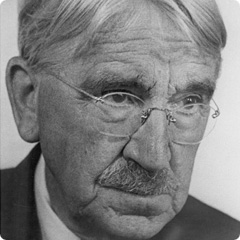
"Technology" signifies all the intelligent techniques by which the energies of nature and man are directed and used in satisfaction of human needs; it cannot be limited to a few outer and comparatively mechanical forms.
--John Dewey
There is obviously a difference between painting a picture and developing a manufacturing plant to make paints and brushes, but what's wrong with solving problems? Is it really so dangerous as philosophers--who aren't typically known for being technologists--seem to think? John Dewey says no, arguing that all inquiry has a technological component insofar as it is meant to solve problems. If moral inquiry helps us solve problems, it's as technological as lasers and airplanes are. Theories are just tools for solving problems.
Understanding technology as problem-solving may seem impossibly vague, but it's actually very powerful. Whenever considering a new gadget, theory, or way of doing things, Dewey suggests we ask: what is the problem this is meant to solve? Remarkably, many new products don't seem aimed at solving any problems, or at least not any serious ones.
What about the problem of collective decision-making? Humans have created two lasting technologies for this purpose: representative governments and markets. Governments are good at ensuring certain behaviors that its people think should be ensured. They define and enforce justice, including the means of determining what justice is. This wasn't always the case and took many years of trial and error. Life used to be filled with a lot more anxiety, because the world was so much more unpredictable, and the means of determining fairness were uncertain.

Governments, however, can only solve certain problems. They're bad at picking market winners, for example, and they're slow to react to change. They are good at prohibiting certain behaviors, but it's hard for them to make citizens moral, healthy, intelligent, or cultured. As Cass Sunstein argues in his book Nudge, the best governments may be able to do is incentivize certain behaviors so that people will make the right choices on their own.
Markets, on the other hand, provide a highly responsive way of determining what people value and what should be produced. As Friedrich Hayek recognized, markets aggregate people's individual choices and values and thus collectivize intelligence in a very efficient manner. Markets will always have the input of more people than governments as well as higher levels of participation. And, since people often know what they want better than 'experts,' markets can be more rational than governments.
Unfortunately, many things cannot be quantified in dollar values, such as the environment, health, or justice. We can adjust markets so that they take hidden costs into account, as cap-and-trade systems do, but these work best when you have a metric that can be easily tied to cost. Another criticism of markets is that people do not always act rationally, as Daniel Kahneman and other behavioral economists have shown. Even if we know what we want, we can't be sure to act accordingly.
Given the limitations of governments and markets, Deweyans turn to small groups for salvation. There are many interesting examples of small-scale collective problems solving, such as the rebirth of Pittsburgh or river management in Mexico, but it's hard to see how such solutions will scale. As our interactions become ever more global, we need globalized methods of collective decision making.

For these reasons, Clay Shirky and other technologists point to the internet as a possible third way of making intelligent choices collectively. It's not enough to say that the internet connects people. The idea of the internet as a 'Global Village' has become a joke, as new technologies help us filter each other out like never before. What Shirky points to is the way the internet lowers barriers to participation. Shirky's poster child is Wikipedia, which, like most internet phenomena, displays a long tail of participation. Many people work together, though the vast majority only contribute a little.
Lowering barriers is great, but it is probably not enough if we are to find a third way to compete with governments and markets. Can new technologies help us better solve collective problems? The question becomes ever more pressing as big players like Google, Microsoft, and Facebook become ever bigger and structure the ways we interact more and more. Not being evil is not the same thing as providing venues for increasing collective intelligence. What other problems should we be trying to solve?


 Most importantly, Heidegger's understanding of technology as means-ends thinking points to the need for other ways of thinking--aesthetic, cultural, social, ecological, religious, political, ethical, philosophical, kinesthetic, you name it. I'm often turned off by tech news, because it reinforces the culture of buying the latest disposable gadget instead of the development of truly important solutions. Rather than fleeing from technology as some Luddites do, we need to imbue technology with the real world technologists often ignore. I like my smartphone, but it's a far cry from the future envisioned by the prognosticators of the 1950's.
