Showing posts with label Object Relation. Show all posts

Sunday, May 19, 2013

Taking Another Look at SQL

The man; the mystery
Many people think they can do without RDBMS's.  But before you say goodbye to the relation forever, I think it's useful to recall the problem for which it was meant to solve.  We've become so used to RDBMS's that their benefits may too close to us to be seen clearly.  I have a new-found appreciation for them after reading Ted Codd's 1981 Turing lecture.

Recall that prior to RDBMS's were DBMS's.  If you had data that you needed to persist, you had two options: file-based storage or hierarchical databases like IBM's IMS.  In either case, data storage code was highly coupled with application code.  If you wanted to add a new field to your customer information in IMS, for example, you had to update all your pointers referencing customer information.  If you wanted to query your data, you had to bake your searches in from the beginning.

One of the main things RDBMS's provided was an abstraction layer between your application code and your data model (your data structures, operators, and integrity rules).  Want to add a new persisted field?  No problem!  Programmers could be more productive by focusing on business logic rather than storage details.


Still, by using a relational data model, RDBMS's do shape application code.  They let you query data in ways you had never planned, but you need to have a system to get your data in and out of them.  Hence the need for ORM.  One of the benefits of NoSQL databases like MongoDB is that they have an incredibly simple key-value-based data model.  You can ignore ORM completely, and thus spend even less time thinking about storage.  (There is a trade-off, of course.  Querying the data becomes more difficult).

If there is a reason to go NoSQL, it's programmer productivity.  NoSQL made a lot of sense for Google in the early 2000's due to the cost of hardware. As the cost of processing power continues to decrease, the need to use commodity hardware should not be a central reason to turn to NoSQL for most people.  Programmer productivity should.

In short, I see the move from DBMS's to RDBMS's and now back to NRDBMS's (non-relational database management systems) as part of a broader trend to abstract away details and work on the interesting stuff.  Just as with garbage-collection in OO languages, we're always looking to get closer to the pure space of thought,

Sunday, May 13, 2012

Object Relations

I recently talked about the architectural problem of mapping objects to databases. A related problem is the behavior of such mappings. Martin Fowler explains, "That behavioral problem is how to get the various objects to load and save themselves to the database." Though the architectural part is not simple (Jeff Atwood calls it the Vietnam of computer science), behavior can be a much more intractable problem.

It's magic
Think about it. If you load a bunch of stuff from the database into memory and then do some work--especially unpredictable work generated by user commands--you have to figure out what to write back to the database. Some things will have changed, and others will not. Some things might have been updated since you last wrote to the database.

The main thing you need is a unit of work, which keeps track of all changes, writes them back to the database, and checks to make sure there are no conflicts when updating. You could, of course, have a 'dirty' flag for each object, and check each one at the end of your unit of work in order what to determine what to write back. But it's often more elegant to create a unit of work object and take care of objects that are new, dirty, or removed. The problem remains of determining the order of write backs.

If you have a lot of overlap between different units of work in a single session, you may want an identity map, which ensures that objects are only loaded once. This way, you can't accidentally modify two different instances of the same information in memory. An identity map could be located in a session object or as a static object in units of work.

Finally, since you may not want to load all objects into memory at the same time, you might consider implementing lazy loading. The idea is that you don't load data until you actually need it. This may defeat the purpose of O/R mapping, if it ends up leading to a lot of separate loads, but it is a natural extension of the identity map.

Now, much hinges on the actual map itself. How do your objects relate to each other and to the database? If your objects simply mirror your database schema, you could use an identity field which stores the primary key for each object / row. If you do this, you'll probably need a foreign key association between objects / tables.

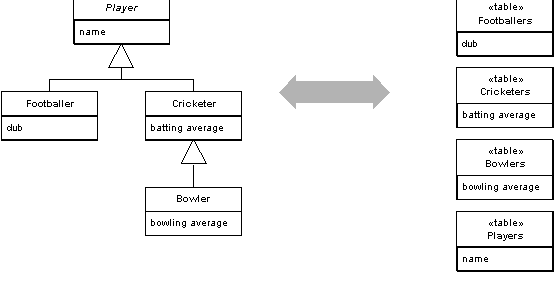
Things become more complicated if you're making use of inheritance. You could have one table to manage an inheritance hierarchy. This is called single table inheritance. This may lead to lots of NULL values in the database table and difficulty in naming things in a single namespace. Another option is to use class table inheritance, in which you have one table for each class. This simplifies the relationship between objects and tables, but it leads to complex joins. You'll also have to be careful about foreign key relationships to other tables, as a primary key cannot be referred to by other tables. A variation on this pattern is what Fowler calls concrete table inheritance, in which you have one table for each level in an inheritance hierarchy. This should help with the foreign key relationships.

An example of class table inheritance

All this would be a lot to implement by hand, which is why Microsoft created the Entity Framework, first introduced in .NET 3.5. Java coders may try Querydsl. I haven't had a ton of experience dealing with OR behavioral issues, but I can understand the appeal of the EF. You can simply build your objects, build the relations, and then export a database from Visual Studio. I worry about the performance of these tools, but they seem flexible enough to allow for customization. Whether or not this customization is worth the development effort required is another question.
Related Posts Plugin for WordPress, Blogger...